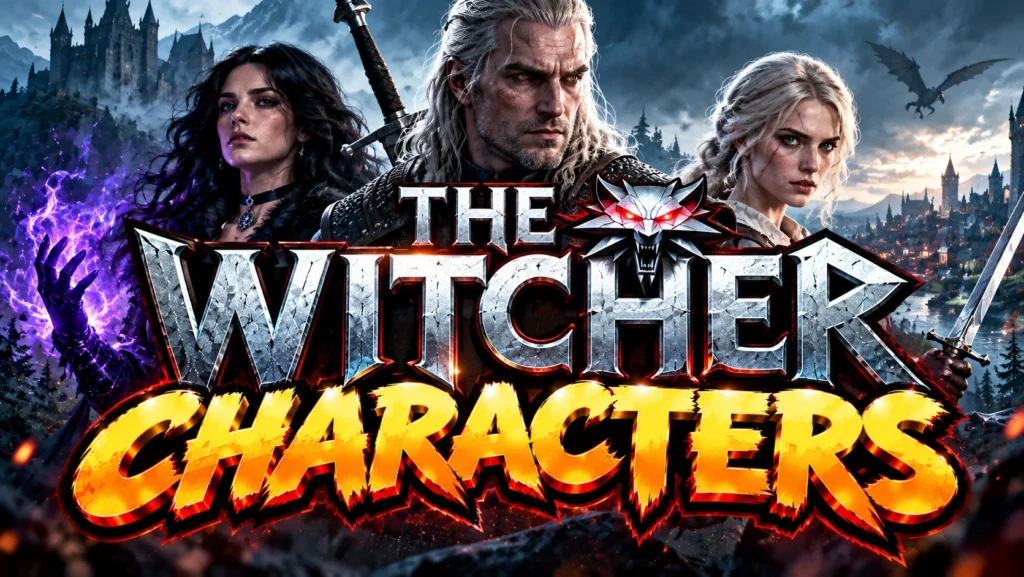
The Witcher characters bring together monster hunters, powerful sorceresses, ambitious rulers, dangerous villains, and unlikely heroes in one of fantasy’s most detailed fictional worlds. Created by Polish author Andrzej Sapkowski, The Witcher began as a series of books before expanding into video games developed by CD Projekt Red and television adaptations, including Netflix’s live-action series.
At the center of the story are Geralt of Rivia, a professional monster hunter; Yennefer of Vengerberg, a formidable sorceress; and Ciri, a young princess whose extraordinary heritage makes her important to the fate of the Continent.
However, the franchise extends far beyond these three protagonists. Witcher schools, magical organizations, royal families, nonhuman communities, and competing kingdoms all contribute memorable personalities to the story.
This guide explores 40 notable The Witcher characters, explaining their identities, personalities, appearances, abilities, affiliations, relationships, and importance. It primarily covers the original books and CD Projekt Red’s games, with television differences identified where relevant.
The Witcher Characters At A Glance
The following directory introduces 40 important characters from The Witcher universe. It includes the main protagonists, fellow witchers, companions, sorceresses, rulers, antagonists, and important characters from the video games and their expansions.
| Character | Role | Affiliation | Known For |
|---|---|---|---|
| Geralt of Rivia | Main protagonist | School of the Wolf | Monster hunting |
| Ciri | Princess and protagonist | Cintra, Geralt’s family | Elder Blood |
| Yennefer | Sorceress | Magical community | Powerful magic |
| Triss Merigold | Sorceress and ally | Lodge of Sorceresses | Fire magic and healing |
| Dandelion (Jaskier) | Bard and companion | Geralt’s friends | Poetry and music |
| Vesemir | Veteran witcher | School of the Wolf | Mentorship |
| Eskel | Witcher | School of the Wolf | Swordsmanship |
| Lambert | Witcher | School of the Wolf | Sarcastic personality |
| Coën | Witcher | School of the Griffin | Combat training |
| Regis | Higher vampire | Geralt’s company | Wisdom and healing |
| Milva | Archer | Geralt’s company | Exceptional archery |
| Cahir | Nilfgaardian knight | Nilfgaard, later Geralt’s company | Redemption |
| Angoulême | Young outlaw | Geralt’s company | Resourcefulness |
| Zoltan Chivay | Dwarf warrior | Geralt’s allies | Loyalty |
| Yarpen Zigrin | Dwarf adventurer | Dwarven communities | Practical wisdom |
| Shani | Medic | Temeria, Oxenfurt | Medical expertise |
| Nenneke | Priestess | Temple of Melitele | Healing and guidance |
| Queen Calanthe | Queen of Cintra | Cintrian monarchy | Strong leadership |
| Pavetta | Cintrian princess | Cintrian royal family | Magical inheritance |
| Emhyr var Emreis | Emperor | Nilfgaardian Empire | Imperial ambition |
| Mousesack | Druid | Cintrian court | Magical knowledge |
| Sigismund Dijkstra | Spymaster | Redania | Intelligence gathering |
| Philippa Eilhart | Sorceress | Lodge of Sorceresses | Political manipulation |
| Keira Metz | Sorceress | Lodge of Sorceresses | Magical knowledge |
| Fringilla Vigo | Sorceress | Nilfgaard, Lodge | Illusion magic |
| Francesca Findabair | Elven sorceress | Elven communities, Lodge | Magical and political influence |
| Tissaia de Vries | Sorceress and teacher | Aretuza | Magical education |
| Vilgefortz | Sorcerer and antagonist | Magical Brotherhood | Ruthless ambition |
| Rience | Mage and pursuer | Vilgefortz’s network | Fire-based magic |
| Leo Bonhart | Bounty hunter | Independent mercenary | Deadly swordsmanship |
| Eredin Bréacc Glas | Wild Hunt leader | Aen Elle | Supernatural pursuit |
| Avallac’h | Elven sage | Aen Elle | Elder Blood knowledge |
| Imlerith | Wild Hunt general | Wild Hunt | Brutal strength |
| Caranthir | Elven navigator | Wild Hunt | Portal magic |
| King Radovid V | Redanian ruler | Redania | Political ruthlessness |
| King Foltest | Temerian ruler | Temeria | Royal politics |
| Philip Strenger | Regional baron | Crow’s Perch | Family tragedy |
| Olgierd von Everec | Nobleman | House von Everec | Supernatural bargain |
| Gaunter O’Dimm | Mysterious antagonist | Independent | Reality-altering powers |
| Duchess Anna Henrietta | Ruler of Toussaint | Toussaint | Political leadership |
The directory covers 40 distinct characters rather than claiming that The Witcher universe contains only 40 characters. Its actual cast is considerably larger across books, games, television, and other adaptations.
Understanding The Witcher Universe And Its Characters
The Witcher takes place mainly on a fictional landmass known as the Continent, where humans, elves, dwarves, monsters, and magical beings inhabit competing kingdoms and territories.
The arrival of monsters and magical creatures is connected to an ancient event called the Conjunction of the Spheres, when different worlds temporarily overlapped.
Witchers were developed through dangerous mutations and specialized training to fight these threats. Although their profession protects ordinary people, many communities distrust them because of their altered physiology and unusual abilities.
Witchers And Their Schools
Witchers are professional monster hunters who undergo intensive physical training and potentially deadly mutations.
Their abilities generally include heightened senses, improved reflexes, exceptional physical conditioning, resistance to certain toxins, and access to simple combat magic called Signs.
The most recognizable Signs include Aard, Igni, Quen, Yrden, and Axii.
Geralt, Vesemir, Eskel, and Lambert are associated with the School of the Wolf, whose headquarters are located at Kaer Morhen.
Other witcher schools feature in the wider franchise, although their histories and prominence differ between the books and expanded game material.
Sorcerers And Sorceresses
Mages form another important class of characters.
Unlike witchers, whose abilities come partly from physical mutations, trained sorcerers and sorceresses learn to control magical forces.
Their influence goes far beyond combat. They serve as advisers, healers, teachers, researchers, spies, and political strategists.
Institutions such as Aretuza train magical practitioners, while organizations such as the Brotherhood of Sorcerers and the Lodge of Sorceresses become deeply involved in the Continent’s political affairs.
Kingdoms, Empires, And Political Factions
The Northern Kingdoms and the Nilfgaardian Empire frequently compete for territory and political dominance.
These conflicts affect ordinary citizens as well as rulers, soldiers, merchants, and nonhuman communities.
Characters such as Emhyr var Emreis, Radovid V, Foltest, and Sigismund Dijkstra demonstrate that political power can be just as dangerous as supernatural magic.
Elder Blood And The Wild Hunt
Elder Blood is a rare hereditary magical lineage associated with Ciri.
Her abilities attract interest from powerful individuals and groups, including the Wild Hunt, an extraordinary force connected to another world.
Understanding Elder Blood helps explain why so many seemingly unrelated characters become involved in Ciri’s story.
Main The Witcher Characters
The three central figures are Geralt of Rivia, Ciri, and Yennefer of Vengerberg. Their relationships establish the emotional foundation of the novels and remain important throughout the video games and television adaptation.
1. Geralt of Rivia
| Detail | Information |
|---|---|
| Full Name | Geralt of Rivia |
| Nicknames | White Wolf, Butcher of Blaviken |
| Species | Mutated human |
| Occupation | Witcher |
| School | School of the Wolf |
| Main Abilities | Swordsmanship, Signs, enhanced senses |
| Important Relationships | Ciri, Yennefer, Dandelion, Vesemir |
| Netflix Actors | Henry Cavill (Seasons 1–3), Liam Hemsworth (Season 4 onward) |
Geralt of Rivia is the primary protagonist of The Witcher and one of the most recognizable monster hunters in fantasy fiction.
His distinctive appearance includes long white hair, pale skin, catlike eyes, and numerous scars accumulated during his dangerous profession. He typically carries steel and silver swords, using different equipment according to the threats he faces.
Geralt’s abilities come from the mutations and training he underwent as a young witcher. His remarkable reflexes, enhanced senses, swordsmanship, and knowledge of monsters allow him to survive encounters that would overwhelm ordinary fighters.
He also uses five primary magical Signs: Aard for telekinetic force, Igni for fire, Quen for protection, Yrden for magical traps, and Axii for mental influence.
Despite his reputation as an emotionally detached professional, Geralt frequently demonstrates compassion. His decisions often reveal a strong personal morality that conflicts with the expectation that witchers should remain neutral.
His relationship with Yennefer is passionate and complicated, while his bond with Ciri develops into a deeply protective father-daughter relationship.
Geralt matters because he connects the franchise’s personal stories with its larger conflicts involving destiny, discrimination, political violence, and the meaning of humanity.
2. Ciri (Cirilla Fiona Elen Riannon)
| Detail | Information |
|---|---|
| Full Name | Cirilla Fiona Elen Riannon |
| Common Name | Ciri |
| Titles | Princess of Cintra, Lion Cub of Cintra |
| Heritage | Elder Blood |
| Family | Pavetta, Duny, Queen Calanthe |
| Adoptive Family | Geralt and Yennefer |
| Skills | Swordsmanship, extraordinary magical abilities |
| Netflix Actress | Freya Allan |
Ciri is one of the most important characters in The Witcher and becomes a central protagonist as the story develops.
Born into the royal family of Cintra, she inherits Elder Blood, a rare lineage connected with exceptional magical potential. Her ancestry makes her valuable to rulers, sorcerers, and other powerful beings.
Ciri is recognizable by her pale hair, green eyes, and determined expression. In The Witcher 3: Wild Hunt, she also bears a prominent facial scar.
Although she trains at Kaer Morhen under experienced witchers, Ciri does not undergo the mutations that turn ordinary humans into witchers.
Instead, she combines physical sword training with unusual magical capabilities, including movement through space and, under extraordinary circumstances, between worlds.
Her personality develops through hardship. She can be compassionate and loyal but also impulsive, defiant, and deeply affected by loss.
Geralt acts as her adoptive father, while Yennefer becomes a maternal figure and magical mentor.
Unlike many conventional fantasy princesses, Ciri’s story is not simply about inheriting a throne. It explores identity, independence, survival, and the struggle to control one’s own destiny.
3. Yennefer of Vengerberg
| Detail | Information |
|---|---|
| Name | Yennefer of Vengerberg |
| Species | Human |
| Occupation | Sorceress |
| Affiliation | Magical community |
| Distinctive Features | Black hair, violet eyes |
| Abilities | Advanced spellcasting, portals, magical protection |
| Important Relationships | Geralt, Ciri, Tissaia de Vries |
| Netflix Actress | Anya Chalotra |
Yennefer of Vengerberg is a powerful sorceress whose intelligence, determination, and emotional complexity make her one of the franchise’s defining characters.
Her appearance is especially distinctive. She has dark hair, violet eyes, and a preference for black-and-white clothing. Her signature scent is associated with lilac and gooseberries.
Yennefer is exceptionally skilled in magic, including protective spells, teleportation, magical investigation, and destructive sorcery.
Her strength comes not only from magical talent but also from her ability to navigate dangerous political situations.
Outwardly, Yennefer can appear proud, demanding, or intimidating. Beneath that exterior, she has a strong capacity for loyalty and affection, particularly toward Geralt and Ciri.
Her relationship with Geralt is marked by recurring conflict, attraction, reconciliation, and shared responsibility.
Yennefer’s desire for motherhood also shapes significant aspects of her story. Her bond with Ciri eventually allows her to become a protective maternal figure.
She represents a combination of extraordinary power and personal vulnerability, making her considerably more complex than a conventional magical mentor.
4. Triss Merigold
Triss Merigold is a sorceress from Maribor and an important friend and ally of Geralt, Ciri, and Yennefer.
In CD Projekt Red’s games, she is especially recognizable for her red hair and colorful clothing, although her physical description differs in certain respects from the original books.
Triss possesses considerable magical knowledge, with fire magic among her most recognizable abilities. She is also associated with healing, although her magical medical capabilities have important limitations.
Her compassionate personality often appears in her willingness to help people facing persecution or political danger.
At the same time, Triss is not free from moral complexity. Her romantic feelings for Geralt create tension with her friendship with Yennefer.
In the original novels, Triss contributes to Ciri’s care and training. The games expand her role significantly, particularly through her relationship with Geralt and her involvement in protecting vulnerable magic users.
Players of The Witcher 3 can make choices that affect Geralt’s romantic future with Triss, but those outcomes belong to the game’s branching narrative rather than a single universally fixed ending.
5. Dandelion (Jaskier)
Dandelion, known as Jaskier in Polish and in Netflix’s television series, is a talented bard, poet, and Geralt’s closest longtime friend.
His personality contrasts sharply with Geralt’s restrained temperament.
Dandelion enjoys music, romance, storytelling, fashionable clothing, and public attention. His colorful appearance and theatrical behavior regularly distinguish him from the more practical people around him.
He frequently gets himself into trouble through romantic entanglements, careless comments, or excessive curiosity.
Nevertheless, Dandelion is much more than comic relief.
He is fiercely loyal to Geralt and often provides emotional support, companionship, and valuable information.
His songs and stories also influence the public reputation of the White Wolf, making him an important bridge between Geralt’s private experiences and the wider world.
In Netflix’s live-action series, Dandelion is portrayed by Joey Batey under the name Jaskier.
Witchers And Kaer Morhen Characters
Kaer Morhen is the historic stronghold of the School of the Wolf. Its surviving witchers help establish Geralt’s upbringing, training, and understanding of his profession.
6. Vesemir
Vesemir is an elderly, highly experienced witcher who serves as a mentor and father figure to Geralt and several other members of the School of the Wolf.
His gray hair, weathered appearance, and calm authority reflect a lifetime of dangerous work.
Although advanced in age, Vesemir remains skilled with swords, knowledgeable about monsters, and familiar with witcher combat techniques.
He is especially important because he preserves traditions that might otherwise disappear as the number of surviving witchers declines.
Vesemir often approaches problems with patience and practical wisdom, contrasting with the impulsive behavior of younger witchers.
His relationship with Geralt is built on years of instruction, mutual respect, and family-like affection.
In The Witcher 3, his guidance remains significant to Ciri and the other defenders of Kaer Morhen.
7. Eskel
Eskel is a witcher from the School of the Wolf and one of Geralt’s oldest companions.
He is easily recognized by the prominent scar across his face. Despite his intimidating appearance, Eskel generally displays a calm, courteous, and thoughtful personality.
Like Geralt, he specializes in swordsmanship, monster tracking, alchemy, and combat Signs.
Eskel prefers a relatively straightforward professional life and usually avoids unnecessary political involvement.
His friendship with Geralt reflects the shared experiences of individuals who endured witcher training together.
The Netflix television adaptation gives Eskel a substantially different storyline from his portrayal in the books and games, so important events involving him should not be assumed to apply across every continuity.
8. Lambert
Lambert is another witcher associated with Kaer Morhen and the School of the Wolf.
His personality is considerably sharper than Eskel’s. He frequently uses sarcasm, complains about the witcher profession, and openly questions the circumstances that led to his mutations.
Lambert’s resentment is rooted partly in the lack of choice that characterized his childhood training.
He is nevertheless a capable monster hunter with strong swordsmanship and knowledge of Signs.
In The Witcher 3, Lambert’s personal history and relationships can be explored through additional quests.
His interactions with Geralt and Eskel provide humor but also demonstrate how different witchers respond emotionally to the same demanding profession.
9. Coën
Coën is a witcher from the School of the Griffin who spends time at Kaer Morhen alongside members of the School of the Wolf.
He is particularly relevant during Ciri’s early training.
Coën helps teach her combat techniques and participates in the supportive environment that allows her to develop physical confidence.
Unlike some of the more cynical witchers, Coën is generally presented as approachable and good-natured.
His participation in the larger conflicts of the Northern Kingdoms also shows that witchers are not always able to remain detached from human political struggles.
Although Coën receives less attention than Geralt or Vesemir, he contributes to the portrayal of Kaer Morhen as a community rather than merely a training fortress.
Geralt’s Companions And Important Allies
Geralt frequently travels with individuals who have very different backgrounds and motivations. His companions include a vampire, an archer, a former enemy, a young outlaw, and several dwarven warriors.
Their friendships demonstrate that shared loyalty can overcome political divisions and personal prejudice.
10. Regis (Emiel Regis Rohellec Terzieff-Godefroy)
Regis is a higher vampire, an experienced healer, and one of the most intellectually sophisticated characters in The Witcher.
Unlike stereotypical vampires, he does not require human blood to survive and can move freely in daylight. He previously struggled with an unhealthy relationship with blood but eventually abandoned its consumption.
Regis possesses extraordinary regenerative capabilities, heightened physical abilities, and extensive knowledge of medicine and herbal remedies.
His outward appearance is generally that of a thoughtful, mature gentleman rather than a terrifying supernatural predator.
He joins Geralt’s traveling company during the novels and contributes medical knowledge, diplomatic judgment, and philosophical insight.
Regis challenges Geralt’s assumptions about monsters because his behavior is often more humane than that of ordinary people.
He also plays an important role in The Witcher 3: Blood and Wine, where his history with another higher vampire becomes central to the expansion’s narrative.
Laurence Fishburne portrays Regis in the fourth season of Netflix’s The Witcher.
11. Milva
Milva, whose real name is Maria Barring, is a skilled archer who becomes one of Geralt’s most dependable companions.
She is strongly associated with Brokilon Forest, where she develops relationships with the dryads and helps individuals traveling through dangerous territory.
Milva’s primary strength is her remarkable accuracy with a bow. Her survival skills and understanding of wilderness environments make her invaluable during Geralt’s journey.
Her personality is direct, independent, and sometimes abrasive. She rarely hesitates to criticize others when she considers their decisions foolish.
Behind that tough exterior, however, she is compassionate and capable of making considerable sacrifices for people she trusts.
Milva’s relationship with Geralt demonstrates how mutual respect can develop between individuals who initially have little reason to cooperate.
In Netflix’s television series, she is portrayed by Meng’er Zhang.
12. Cahir Mawr Dyffryn aep Ceallach
Cahir is a knight from Vicovaro who initially serves the Nilfgaardian Empire.
His early connection to Ciri creates fear and mistrust, particularly because she associates him with traumatic events from her childhood.
Cahir’s distinctive black helmet, decorated with birdlike wings, contributes to his intimidating image.
As his story develops in the novels, he becomes increasingly independent of his original imperial mission and eventually joins Geralt’s company.
This transition is important because it explores guilt, redemption, and the possibility of changing one’s loyalties.
Cahir is a capable swordsman and experienced soldier, but his greatest narrative significance comes from his determination to move beyond earlier mistakes.
Geralt initially distrusts him, yet their relationship gradually changes through shared danger.
Eamon Farren portrays Cahir in Netflix’s adaptation, where his storyline differs in several respects from the books.
13. Angoulême
Angoulême is a young woman with a troubled background who becomes a member of Geralt’s traveling company.
She previously belongs to an outlaw group and has experience surviving through deception, crime, and dangerous social circumstances.
Angoulême is recognizable for her youthful appearance, sharp tongue, and outspoken personality.
Although she lacks the supernatural abilities of witchers and sorceresses, her practical intelligence and familiarity with criminal networks make her useful.
Her humor often provides relief during an otherwise difficult journey.
Angoulême is also notable for her growing loyalty to Geralt and his companions, who offer her a sense of belonging she previously lacked.
Her character demonstrates that courage and personal worth are not determined by noble birth, magical talent, or social respectability.
14. Zoltan Chivay
Zoltan Chivay is a dwarf warrior and adventurer whose friendship with Geralt develops into one of the most enduring relationships in the franchise.
He has a sturdy physical build, a prominent beard, and the practical equipment of an experienced traveler.
Zoltan enjoys drinking, gambling, storytelling, and spending time with his companions.
His personality combines humor, skepticism, generosity, and considerable personal courage.
He is an effective fighter who commonly uses an axe and other conventional weapons.
Although Zoltan sometimes appears rough or argumentative, he strongly values loyalty and friendship.
In The Witcher 3, he becomes an important supporting character in Novigrad, where his connections to Dandelion and Geralt help drive several quests.
Zoltan also provides a perspective on the discrimination and political difficulties experienced by nonhuman communities.
15. Yarpen Zigrin
Yarpen Zigrin is a dwarven adventurer, warrior, and veteran of numerous dangerous journeys.
He is known for his direct manner, practical intelligence, and willingness to challenge romantic ideas about heroism.
Yarpen frequently speaks plainly about politics, warfare, and the difficulties faced by dwarves and other nonhuman peoples.
His experience makes him a useful companion in combat and a perceptive observer of human behavior.
Unlike characters driven primarily by destiny or magical ambition, Yarpen often focuses on survival, economic realities, and the consequences of political decisions.
His interactions with Geralt and Ciri contribute to the books’ exploration of prejudice and loyalty.
He is especially memorable because he combines a rough exterior with moments of genuine thoughtfulness.
16. Shani
Shani is a talented medic who appears in the original books and several Witcher games.
She is strongly associated with medical training, practical treatment, and helping people injured by warfare or disease.
Unlike magical healers, Shani primarily relies on medical knowledge, observation, and conventional treatment.
Her compassionate personality is balanced by a realistic understanding of suffering and mortality.
Shani has a romantic connection with Geralt in parts of the franchise, although the nature and importance of their relationship vary across the books and game narratives.
She has a significant role in the first Witcher game and returns in the Hearts of Stone expansion.
Her presence adds a grounded perspective to a universe frequently dominated by supernatural abilities.
17. Nenneke
Nenneke is the respected high priestess of the Temple of Melitele in Ellander.
She is an important maternal and advisory figure in Geralt’s life, offering medical care, spiritual guidance, and sometimes blunt criticism.
Nenneke has extensive knowledge of herbs, healing, and religious traditions.
Her personality is firm, practical, and compassionate. She does not hesitate to challenge Geralt when she believes he is behaving irresponsibly.
The temple provides a comparatively peaceful environment where injured travelers and individuals seeking assistance can recover.
Nenneke’s significance lies in her ability to offer stability and wisdom without relying on political authority.
Her relationship with Geralt also reveals the importance of longstanding personal connections outside the witcher profession.
Cintrian Royal Family And Destiny-Linked Characters
The royal family of Cintra occupies a central position in The Witcher’s larger narrative.
Its history connects Geralt’s personal choices to political events and Ciri’s extraordinary ancestry.
18. Queen Calanthe
Queen Calanthe, often called the Lioness of Cintra, is Ciri’s grandmother and a formidable ruler.
Her reputation comes from her strong personality, political intelligence, and determination to protect her kingdom.
Calanthe refuses to behave like a passive monarch. She takes an active interest in military affairs, political decisions, and the future of her dynasty.
Her relationship with Princess Pavetta is particularly important because she initially struggles with the implications of her daughter’s destiny.
Calanthe’s interactions with Geralt help establish the circumstances that eventually connect him to Ciri.
Although her decisions can appear uncompromising, they often emerge from her responsibility as both a ruler and a grandmother.
In Netflix’s television adaptation, Calanthe is portrayed by Jodhi May.
19. Pavetta
Pavetta is the daughter of Queen Calanthe and the mother of Ciri.
As a Cintrian princess, her marriage carries considerable political importance.
However, Pavetta’s personal story becomes inseparable from magical destiny through her relationship with Duny.
She possesses unusual magical abilities that become especially evident during a significant royal gathering.
Pavetta’s powers are connected to the hereditary magical lineage later associated with Ciri.
Her role is comparatively brief, but her influence extends across the entire saga because her family relationships help establish Ciri’s ancestry.
Pavetta demonstrates how personal relationships, royal obligations, and supernatural forces can become dangerously intertwined.
20. Emhyr var Emreis
| Detail | Information |
|---|---|
| Full Name | Emhyr var Emreis |
| Title | Emperor of Nilfgaard |
| Earlier Identity | Duny, the Urcheon of Erlenwald |
| Family | Pavetta and Ciri |
| Main Strengths | Political strategy, imperial leadership |
| Affiliation | Nilfgaardian Empire |
| Netflix Actor | Bart Edwards |
Emhyr var Emreis is the powerful emperor of Nilfgaard and one of the most politically influential characters in the franchise.
His ambition shapes major conflicts involving the Northern Kingdoms and the future of the Continent.
Emhyr is intelligent, calculating, disciplined, and willing to make ruthless decisions to achieve imperial objectives.
He commands military resources, political agents, and intelligence networks, making him dangerous without relying on personal supernatural combat abilities.
His earlier identity as Duny connects him directly to the Cintrian royal family and Ciri.
This relationship becomes one of the saga’s most consequential revelations.
In The Witcher 3, Emhyr’s imperial power and interest in Ciri remain important elements of the story.
His portrayal illustrates the tension between political responsibility, dynastic ambition, and personal relationships.
21. Mousesack (Ermion)
Mousesack is a druid closely associated with Queen Calanthe and the royal court of Cintra.
He is known for his magical knowledge, practical wisdom, and protective attitude toward the people entrusted to his care.
In the books and television adaptation, Mousesack contributes to the early story surrounding Pavetta, Ciri, and Geralt.
The video games feature him under the name Ermion, particularly in The Witcher 3.
In the game continuity, he serves as an important druid associated with Skellige and possesses extensive knowledge of magical rituals and local traditions.
His personality is thoughtful and frequently cautious, reflecting a deep respect for natural and supernatural forces.
Mousesack’s role is important because he connects magical scholarship with political responsibility and cultural traditions.
Sorceresses And Magical Characters
Sorceresses occupy some of the highest positions of influence in The Witcher universe. Their magical abilities, political alliances, and personal ambitions shape events across the Continent.
The following characters are especially important for understanding Aretuza, the Brotherhood of Sorcerers, the Lodge of Sorceresses, and the wider struggle for magical influence.
22. Sigismund Dijkstra
Sigismund Dijkstra is a highly intelligent spymaster associated with the Kingdom of Redania.
Although he possesses no notable supernatural powers, his political knowledge and intelligence network make him one of the Continent’s most dangerous strategists.
Dijkstra is physically imposing and frequently relies on manipulation, negotiation, and carefully collected information.
His personality combines ambition, sharp humor, cynicism, and considerable patience.
He maintains important political connections, including a complicated working relationship with Philippa Eilhart.
In The Witcher 3, Dijkstra operates in Novigrad, where his involvement in underground activities and Redanian politics affects several major quests.
His character demonstrates that information can be a weapon as powerful as a witcher’s sword.
23. Philippa Eilhart
Philippa Eilhart is an exceptionally powerful sorceress and an influential political strategist.
She is closely associated with the Redanian court and becomes a leading figure in the Lodge of Sorceresses.
Philippa is notable for her ability to transform into an owl, a magical talent that reflects her advanced command of sorcery.
Her personality is confident, secretive, calculating, and fiercely independent.
She believes that powerful mages should play a decisive role in shaping the Continent’s political future.
This conviction often puts her at odds with rulers and other individuals who resist magical interference.
Philippa’s relationship with Dijkstra is important to her political history, although their interests do not always align.
In the games, she remains a controversial figure whose intelligence and magical strength make her both a valuable ally and a dangerous opponent.
24. Keira Metz
Keira Metz is a sorceress associated with the Lodge of Sorceresses and the former royal court of Temeria.
She is recognizable for her blonde hair, fashionable appearance, and confident personality.
Keira is skilled in magical protection, illusions, teleportation, and other advanced spells.
Although she enjoys comfort and luxury, she is also resourceful enough to survive difficult political circumstances.
In The Witcher 3, Geralt encounters Keira in Velen, where she becomes involved in quests concerning magical research and dangerous discoveries.
Her storyline highlights the vulnerability of mages during periods of persecution.
Player decisions can significantly influence her fate in the game, demonstrating the importance of moral choices in its branching narrative.
Keira combines intelligence and personal ambition with a strong instinct for self-preservation.
25. Fringilla Vigo
Fringilla Vigo is a Nilfgaardian sorceress and a member of the Lodge of Sorceresses.
She has considerable experience with magical illusions and other sophisticated forms of spellcasting.
Fringilla is politically perceptive and skilled at maintaining a controlled outward appearance.
In the novels, she plays an important role during Geralt’s time in Toussaint, where her relationship with him becomes entangled with larger magical and political objectives.
Her loyalty and motivations cannot always be reduced to a simple division between good and evil.
The Netflix adaptation considerably expands and reinterprets her involvement in Nilfgaardian politics.
In that series, she is portrayed by Mimî M. Khayisa.
Fringilla’s character demonstrates how magical ability can be used for personal influence, diplomacy, and political maneuvering rather than direct combat alone.
26. Francesca Findabair
Francesca Findabair, also known as Enid an Gleanna, is an elven sorceress renowned for her beauty, magical expertise, and political influence.
She is associated with the elven population of the Continent and later becomes involved with the Lodge of Sorceresses.
Francesca’s character is particularly important to the political struggles surrounding nonhuman communities.
Her sophisticated magical abilities allow her to operate among powerful human and elven leaders.
She often approaches political problems pragmatically, even when her decisions create difficult moral questions.
Her responsibilities to elven interests sometimes conflict with the objectives of other sorceresses.
Francesca represents the complicated intersection of magical power, national identity, and the struggle for nonhuman autonomy.
Her role is considerably expanded and altered in Netflix’s television adaptation.
27. Tissaia de Vries
Tissaia de Vries is a highly respected sorceress and an important authority in magical education.
She is especially associated with Aretuza, the academy that trains young women in magic.
Tissaia values discipline, precision, academic excellence, and strict control over magical abilities.
Her personality may appear severe, but she genuinely believes that magic should be practiced responsibly.
She also serves as an influential figure within the broader magical establishment.
In Netflix’s adaptation, Tissaia’s relationship with Yennefer receives substantially more dramatic attention.
MyAnna Buring portrays her in the television series.
Tissaia is important because she demonstrates the benefits and limitations of traditional magical institutions. Her commitment to established principles places her in difficult situations when personal loyalties and political developments conflict.
Major Villains And Dangerous Antagonists
The Witcher villains are rarely defined by physical strength alone. Many use political influence, magical knowledge, deception, or psychological manipulation to achieve their objectives.
Some antagonists appear primarily in the novels, while others receive particularly important roles in the games.
28. Vilgefortz of Roggeveen
Vilgefortz is an extraordinarily powerful sorcerer and one of the principal antagonists of the original Witcher saga.
Initially associated with the Brotherhood of Sorcerers, he possesses exceptional magical ability and considerable political influence.
Vilgefortz is highly intelligent, ambitious, manipulative, and ruthlessly determined to expand his power.
Unlike sorcerers who rely exclusively on spells, he is also a dangerous physical combatant.
His sophisticated understanding of magic makes him a formidable opponent even for experienced witchers.
Vilgefortz is especially significant because his ambitions intersect with Ciri’s extraordinary heritage and the larger struggle over magical power.
His character demonstrates how intellectual brilliance can become destructive when separated from ethical restraint.
In Netflix’s adaptation, Vilgefortz is portrayed by Mahesh Jadu.
29. Rience
Rience is a ruthless mage who works in the service of Vilgefortz.
His primary role involves gathering information, pursuing important targets, and intimidating individuals connected to Ciri.
Rience frequently uses fire-based magic, making his attacks particularly dangerous.
He is recognizable in the books for the severe facial burns he suffers during his pursuit of information.
His personality is cruel, arrogant, and openly threatening.
Unlike Vilgefortz, who often operates through strategic manipulation, Rience functions as a direct enforcer.
He provides a recurring physical threat while helping demonstrate the larger network of agents pursuing Ciri.
The Netflix television series also features Rience, although the precise events surrounding his storyline differ from the novels.
30. Leo Bonhart
Leo Bonhart is a notorious bounty hunter and one of the most frightening human antagonists in The Witcher.
He has no established magical powers or witcher mutations. Instead, his danger comes from extraordinary swordsmanship, experience, and ruthless efficiency.
Bonhart is typically depicted as tall, thin, and physically intimidating.
His personality is sadistic, cold, and psychologically manipulative.
He takes pleasure in demonstrating his superiority over opponents and has little regard for human suffering.
His connection to Ciri makes him especially important during later parts of the original saga.
Bonhart serves as a reminder that ordinary humans can be just as terrifying as supernatural monsters.
In Netflix’s fourth season, he is portrayed by Sharlto Copley.
31. Eredin Bréacc Glas
| Detail | Information |
|---|---|
| Name | Eredin Bréacc Glas |
| Species | Aen Elle elf |
| Role | Leader of the Wild Hunt |
| Affiliation | Wild Hunt |
| Main Strengths | Swordsmanship, military command |
| Main Appearance | The Witcher 3: Wild Hunt |
Eredin Bréacc Glas is the leader of the Wild Hunt and a major antagonist in The Witcher 3: Wild Hunt.
He belongs to the Aen Elle, an elven people associated with another world.
Eredin wears imposing armor and leads a group of riders whose frightening appearance contributes to supernatural legends throughout the Continent.
His combat abilities include advanced swordsmanship and formidable physical strength.
As a leader, he is disciplined, authoritarian, and determined to achieve his objectives through force.
The Wild Hunt’s interest in Ciri is connected to her unusual ability to travel between worlds.
Eredin’s importance extends beyond his role as a powerful enemy because he represents the dangers associated with interdimensional conflict and the exploitation of magical abilities.
32. Avallac’h
Avallac’h, whose full name is Crevan Espane aep Caomhan Macha, is an Aen Elle elven sage with extensive knowledge of Elder Blood.
He is a highly intelligent and mysterious figure whose motivations are not always easy to interpret.
Avallac’h possesses advanced magical abilities, particularly those associated with traveling between worlds and understanding unusual magical phenomena.
His relationship with Ciri becomes increasingly important in The Witcher 3.
Although he sometimes provides assistance, his secretive behavior creates uncertainty about his true objectives.
Avallac’h is not simply another conventional villain. He occupies an ambiguous position shaped by elven history, personal motivations, and the extraordinary possibilities of Ciri’s ancestry.
His character introduces some of the franchise’s most important ideas about interdimensional travel and the history of the Elder Blood lineage.
33. Imlerith
Imlerith is a powerful general of the Wild Hunt who serves under Eredin.
He is recognizable for his enormous armored figure, threatening helmet, and massive weaponry.
His primary strength is overwhelming physical combat.
Unlike more subtle antagonists, Imlerith relies on brute force, intimidation, and relentless aggression.
His heavy armor and formidable weapon make him particularly dangerous in close combat.
In The Witcher 3, Imlerith becomes a significant opponent during the struggle against the Wild Hunt.
His character represents the military brutality of Eredin’s forces and their willingness to use violence to accomplish their objectives.
Imlerith is principally a game character rather than an important figure from the original novels.
34. Caranthir Ar-Feiniel
Caranthir is an exceptionally gifted Aen Elle mage and navigator associated with the Wild Hunt.
He is recognizable for his elaborate armor, magical staff, and controlled demeanor.
Caranthir’s magical talents include creating portals, manipulating cold-based forces, and using advanced teleportation techniques.
His ability to move forces across enormous distances makes him strategically valuable to Eredin.
Unlike Imlerith, who specializes in physical domination, Caranthir relies heavily on magical techniques and battlefield control.
His abilities make him particularly dangerous when fighting opponents who depend on conventional weapons.
In The Witcher 3, he is an important adversary during the conflict involving Ciri and the Wild Hunt.
Kings And Political Characters
Political leaders shape the setting of The Witcher through warfare, alliances, succession disputes, and rivalries.
Their decisions often create consequences for individuals who have little interest in royal power.
35. King Radovid V
Radovid V, commonly known as Radovid the Stern, is the ruler of Redania during the events of The Witcher 3.
He is intelligent, suspicious, and increasingly ruthless in his political methods.
Radovid’s authority is reinforced by military strength and an extensive network of political agents.
He is particularly associated with persecution of magic users in the game continuity.
His hostility toward sorcerers and sorceresses creates considerable suffering and contributes to growing instability.
Radovid’s behavior illustrates the danger of combining absolute political authority with fear and obsession.
His fate in The Witcher 3 can be affected by the player’s decisions.
The television adaptation uses a significantly different characterization of Radovid, including changes to his family position and personal relationships.
36. King Foltest
King Foltest is the ruler of Temeria and an important political figure in the Northern Kingdoms.
He is known for his forceful personality, military interests, and willingness to make difficult political decisions.
Foltest’s personal life includes complicated family relationships that become relevant to Geralt’s monster-hunting work.
His royal responsibilities require him to balance domestic stability with the growing threat of Nilfgaardian expansion.
In The Witcher 2: Assassins of Kings, Foltest occupies a particularly significant position in the opening events.
His character helps establish the political circumstances surrounding the conflict between Northern rulers and the Nilfgaardian Empire.
Foltest is neither a conventional heroic monarch nor a purely malicious ruler; his actions reflect the difficult choices and personal flaws of a powerful medieval-style king.
Notable Characters From The Witcher 3 And Its Expansions
The Witcher video games introduce and develop numerous original characters alongside those inherited from the novels.
Some of the franchise’s most memorable supporting stories belong to individuals whose conflicts are smaller in scale than Ciri’s destiny but equally important for exploring morality, grief, and difficult decisions.
37. Philip Strenger (The Bloody Baron)
Philip Strenger, commonly called the Bloody Baron, is one of the most emotionally complicated supporting characters in The Witcher 3: Wild Hunt.
He is a former soldier who controls Crow’s Perch in Velen.
The Bloody Baron is physically imposing, heavily built, and recognizable for his military clothing and commanding presence.
His personality combines rough humor, aggression, regret, and an unstable sense of responsibility.
Although he sometimes presents himself as a charismatic leader, his personal history includes domestic abuse, alcoholism, and serious harm to his family.
Geralt becomes involved in his story while searching for information about Ciri.
The resulting questline explores guilt, accountability, family trauma, and the consequences of violence.
The Bloody Baron is memorable because the game does not reduce him to an innocent victim or a simple villain. His actions have consequences that cannot be erased merely by expressing regret.
38. Olgierd von Everec
Olgierd von Everec is a nobleman and central character in The Witcher 3: Hearts of Stone.
He is recognizable for his distinctive hairstyle, elegant clothing, and unusual confidence in dangerous situations.
Olgierd possesses extraordinary supernatural protection arising from a bargain with a mysterious figure.
His inability to experience life normally becomes one of the most important aspects of his character.
At first, he appears arrogant, cruel, and emotionally detached.
However, the expansion gradually reveals a more complicated history involving love, ambition, loss, and the consequences of desperate decisions.
His relationship with Iris von Everec is particularly important to understanding his motivations.
Olgierd’s storyline explores whether wealth, power, and supernatural advantages have any value when they come at the expense of human connection.
39. Gaunter O’Dimm
Gaunter O’Dimm, also known as Master Mirror or the Man of Glass, is one of the most mysterious and dangerous antagonists in The Witcher franchise.
He appears outwardly as an ordinary, well-spoken man, making his true nature especially unsettling.
His abilities go far beyond conventional spellcasting.
He demonstrates extraordinary control over reality, including the apparent ability to stop time, manipulate circumstances, and enforce supernatural bargains.
Gaunter frequently offers assistance to individuals who desire wealth, power, freedom, or some other seemingly unattainable objective.
However, his agreements often contain dangerous conditions and unexpected consequences.
His calm manner and intellectual confidence contrast sharply with the terrifying nature of his powers.
Gaunter’s actual origin and full nature remain deliberately mysterious.
In Hearts of Stone, his manipulation of Olgierd and Geralt drives much of the expansion’s central conflict.
He represents the danger of agreements made without fully understanding their consequences.
40. Duchess Anna Henrietta
Anna Henrietta is the ruling duchess of Toussaint, a wealthy and culturally distinctive region featured prominently in The Witcher 3: Blood and Wine.
She belongs to a noble family and occupies a position of substantial political authority.
Anna Henrietta is recognizable for her elegant clothing, regal appearance, and commanding personality.
She values courtly etiquette, regional pride, and the reputation of Toussaint.
Her personality combines warmth, determination, impatience, and considerable political confidence.
Anna Henrietta also has complicated personal relationships that influence the events of Blood and Wine.
As duchess, she must balance royal responsibilities with emotional attachments and the dangers affecting her people.
Her character provides an important contrast to the rulers of the war-torn Northern Kingdoms.
Toussaint appears peaceful and prosperous, but Anna Henrietta’s story reveals that its noble society has serious conflicts beneath its polished appearance.
Who Are The Main Characters In The Witcher?
The central characters of The Witcher are Geralt of Rivia, Ciri, and Yennefer of Vengerberg. Their relationships connect the story’s major themes of destiny, family, freedom, and personal responsibility.
| Main Character | Narrative Importance | Main Conflict |
|---|---|---|
| Geralt of Rivia | Principal monster hunter and protector | Morality versus neutrality |
| Ciri | Princess and central figure of destiny | Independence versus exploitation |
| Yennefer | Powerful sorceress and maternal figure | Personal relationships versus ambition |
| Dandelion | Geralt’s closest longtime friend | Loyalty amid danger |
| Triss Merigold | Important magical ally | Personal desires versus responsibility |
Geralt, Ciri, and Yennefer form the primary emotional family of the saga.
Dandelion and Triss are also significant because their relationships with the central trio influence several important storylines.
The games place additional emphasis on characters such as Vesemir, Eredin, and the rulers of the Northern Kingdoms.
Important Character Groups And Factions
The characters of The Witcher become easier to understand when organized according to their principal relationships and affiliations.
| Group Or Faction | Important Characters | Main Function |
|---|---|---|
| School of the Wolf | Geralt, Vesemir, Eskel, Lambert | Monster hunting and training |
| Geralt’s traveling company | Geralt, Dandelion, Regis, Milva, Cahir, Angoulême | Searching for Ciri |
| Lodge of Sorceresses | Philippa, Triss, Keira, Fringilla, Francesca | Magical and political influence |
| Cintrian royal family | Calanthe, Pavetta, Ciri | Royal succession and ancestry |
| Nilfgaardian Empire | Emhyr, Cahir, Fringilla | Imperial politics |
| Redanian leadership | Radovid, Dijkstra | Political and military intelligence |
| Wild Hunt | Eredin, Imlerith, Caranthir | Pursuit of interdimensional objectives |
| Aretuza | Tissaia, Yennefer and other trained sorceresses | Magical education |
| Toussaint nobility | Anna Henrietta, Olgierd’s story is separate from this court | Regional aristocratic politics |
School Of The Wolf
The School of the Wolf is Geralt’s witcher school, headquartered at Kaer Morhen.
Its surviving members share the experience of harsh training, dangerous mutations, and professional monster hunting.
Although individual personalities vary, the witchers generally understand one another’s hardships in ways that ordinary humans cannot.
Geralt’s Traveling Company
Geralt’s traveling company, often called his hansa, forms during the novel saga.
Its members include Dandelion, Milva, Cahir, Regis, and Angoulême.
Each contributes different strengths, from archery and medicine to military experience and practical survival skills.
The group demonstrates that loyalty is not dependent on race, nationality, profession, or supernatural ability.
The Lodge Of Sorceresses
The Lodge of Sorceresses emerges as an influential magical organization following the breakdown of the older Brotherhood of Sorcerers.
Philippa Eilhart plays a leading role in its creation and political direction.
Its members seek to influence major events through diplomacy, magical knowledge, and political planning.
However, individual sorceresses frequently have conflicting loyalties and priorities.
The Wild Hunt
The Wild Hunt is a group of powerful Aen Elle riders associated with interdimensional travel.
Its frightening appearance leads many ordinary inhabitants of the Continent to interpret it as a supernatural omen.
In The Witcher 3, Eredin leads the group, while Imlerith and Caranthir serve as important commanders and specialists.
Their pursuit of Ciri forms a central conflict in the game’s main storyline.
The Witcher Character Relationships Explained
Family, friendship, rivalry, and political manipulation are central to the franchise.
The most important relationships often influence major decisions more strongly than military orders or magical objectives.
| Character | Related Character | Relationship | Why It Matters |
|---|---|---|---|
| Geralt | Ciri | Adoptive father figure | Central family bond |
| Yennefer | Ciri | Maternal figure and mentor | Magical training and protection |
| Geralt | Yennefer | Romantic partners | Central emotional relationship |
| Geralt | Dandelion | Close friends | Companionship and loyalty |
| Geralt | Vesemir | Student and mentor | Witcher upbringing |
| Geralt | Eskel | Longtime friends | Shared childhood training |
| Geralt | Triss | Friends and romantic history | Personal complications |
| Ciri | Calanthe | Granddaughter and grandmother | Cintrian ancestry |
| Ciri | Pavetta | Daughter and mother | Elder Blood inheritance |
| Ciri | Emhyr | Daughter and father | Imperial and family conflict |
| Philippa | Dijkstra | Former partners and political associates | Redanian intrigue |
| Vilgefortz | Rience | Superior and subordinate | Pursuit of Ciri |
| Eredin | Caranthir | Leader and subordinate | Wild Hunt operations |
| Eredin | Imlerith | Commander and general | Military power |
| Olgierd | Gaunter O’Dimm | Supernatural agreement | Hearts of Stone conflict |
| Anna Henrietta | Syanna | Sisters | Blood and Wine storyline |
Geralt And Ciri
Geralt and Ciri share one of the most important relationships in the series.
Their connection begins through the Law of Surprise, a customary promise that can bind an individual to something the promisor possesses but does not yet know about.
However, their relationship eventually becomes much more meaningful than a supernatural obligation.
Geralt chooses to protect Ciri because he genuinely cares about her.
Geralt And Yennefer
Geralt and Yennefer’s relationship is emotionally intense and frequently complicated.
Both characters are strong-willed, independent, and reluctant to surrender personal freedom.
Their disagreements create repeated tension, but their shared responsibility for Ciri becomes a powerful unifying influence.
Ciri And Yennefer
Yennefer initially becomes involved in Ciri’s magical education.
Their relationship gradually develops into a maternal bond based on affection, trust, and protection.
This connection is important because Ciri’s extraordinary magical inheritance requires guidance from someone capable of understanding its dangers.
Geralt And His Fellow Witchers
Vesemir, Eskel, and Lambert represent Geralt’s closest surviving connections to his early life.
Their shared upbringing allows them to relate through humor, mutual respect, and difficult memories.
Kaer Morhen becomes a symbolic family home despite the hardship associated with witcher training.
The Witcher Character Powers And Abilities
Powers in The Witcher are not distributed equally. Some characters rely on mutations, others practice learned magic, while figures such as Ciri possess exceptional hereditary abilities.
| Character | Main Powers Or Skills | Important Limitations |
|---|---|---|
| Geralt | Enhanced senses, Signs, swordsmanship | Signs are limited compared with advanced sorcery |
| Ciri | Space-time abilities, swordsmanship | Control and circumstances affect her abilities |
| Yennefer | Advanced spellcasting, portals | Magic requires skill and available energy |
| Triss | Sorcery, fire magic, medical knowledge | Healing abilities are not unlimited |
| Vesemir | Witcher mutations, swords, Signs | Aging and physical vulnerability |
| Eskel | Swordsmanship, monster hunting, Signs | Mortal despite mutations |
| Lambert | Combat Signs, swordsmanship | Mortal despite mutations |
| Regis | Regeneration, vampire abilities | Extremely powerful magic can threaten him |
| Milva | Exceptional archery | Ordinary human vulnerability |
| Cahir | Swordsmanship, military experience | No witcher mutations |
| Philippa | Transformation, advanced sorcery | Vulnerable to political and magical opposition |
| Keira | Illusions, portals, protective magic | Requires appropriate magical resources |
| Vilgefortz | Advanced destructive magic, combat | Not invulnerable |
| Eredin | Swordsmanship, Aen Elle abilities | Can be defeated in combat |
| Caranthir | Teleportation, ice-based magic | Vulnerable when overcome in battle |
| Imlerith | Strength, heavy-weapon combat | Relies heavily on physical combat |
| Gaunter O’Dimm | Extraordinary reality manipulation | Nature and full limits remain unexplained |
What Are Witcher Signs?
Witcher Signs are relatively simple magical techniques used during combat and other dangerous situations.
Their five principal forms are:
- Aard: Releases a telekinetic force capable of pushing or disrupting targets.
- Igni: Produces fire that can ignite or injure enemies.
- Quen: Creates a protective magical shield.
- Yrden: Establishes a magical trap or controlled area.
- Axii: Influences the mind of another individual.
Games expand the practical applications of Signs through upgrades and gameplay mechanics.
Who Has The Most Unusual Powers?
Ciri possesses some of the franchise’s most extraordinary abilities because of her Elder Blood heritage.
Gaunter O’Dimm also demonstrates powers that exceed the capabilities normally associated with witchers and conventional sorcerers.
However, comparing them through a single definitive power ranking would be misleading because their abilities operate according to different circumstances and narrative rules.
The Witcher Characters And Netflix Actors
Netflix’s live-action adaptation features many familiar characters while making significant changes to their stories and relationships.
The table below identifies notable performers from the television series.
| Character | Netflix Actor |
|---|---|
| Geralt of Rivia | Henry Cavill (Seasons 1–3); Liam Hemsworth (Season 4 onward) |
| Ciri | Freya Allan |
| Yennefer | Anya Chalotra |
| Triss Merigold | Anna Shaffer |
| Jaskier (Dandelion) | Joey Batey |
| Vesemir | Kim Bodnia |
| Eskel | Basil Eidenbenz |
| Lambert | Paul Bullion |
| Coën | Yasen Atour |
| Regis | Laurence Fishburne |
| Milva | Meng’er Zhang |
| Cahir | Eamon Farren |
| Zoltan Chivay | Danny Woodburn |
| Yarpen Zigrin | Jeremy Crawford |
| Nenneke | Adjoa Andoh |
| Queen Calanthe | Jodhi May |
| Pavetta | Gaia Mondadori |
| Emhyr var Emreis | Bart Edwards |
| Mousesack | Adam Levy |
| Dijkstra | Graham McTavish |
| Philippa Eilhart | Cassie Clare |
| Keira Metz | Safiyya Ingar |
| Fringilla Vigo | Mimî M. Khayisa |
| Francesca Findabair | Mecia Simson |
| Tissaia de Vries | MyAnna Buring |
| Vilgefortz | Mahesh Jadu |
| Rience | Chris Fulton, later Sam Woolf |
| Leo Bonhart | Sharlto Copley |
| King Radovid | Hugh Skinner |
| King Foltest | Shaun Dooley |
Not every character from the novels and games appears in the Netflix adaptation. Characters such as Gaunter O’Dimm and Olgierd von Everec are particularly associated with the games rather than the main live-action television storyline.
The Witcher Books, Games, And Netflix Character Differences
The Witcher franchise contains several related but distinct interpretations of its characters.
The original books establish the primary literary continuity. CD Projekt Red’s games build a separate continuation inspired by those books, while Netflix adapts and reinterprets many of the original events.
| Aspect | Original Books | Video Games | Netflix Series |
|---|---|---|---|
| Geralt | Central protagonist | Main playable hero of original trilogy | Portrayed by Cavill, then Hemsworth |
| Ciri | Central figure of the saga | Playable during selected Witcher 3 sequences | Expanded screen storyline |
| Yennefer | Major protagonist | Important in The Witcher 3 | Extensive original characterization |
| Triss | Supporting sorceress | Expanded role and romance options | Adapted storyline |
| Vesemir | Experienced witcher mentor | Significant Kaer Morhen role | Reinterpreted events |
| Wild Hunt | Connected with Aen Elle mythology | Primary enemy faction in Witcher 3 | Different emphasis and development |
| Regis | Important traveling companion | Returns in Blood and Wine | Introduced in Season 4 |
| Gaunter O’Dimm | Not an original novel character | Major Hearts of Stone figure | Not part of the established main TV cast |
Geralt’s Character Across Adaptations
Geralt’s essential identity remains relatively consistent: he is a mutated monster hunter whose apparent emotional detachment hides a strong personal conscience.
However, his dialogue, behavior, relationships, and specific adventures differ between versions.
The games give players a degree of influence over Geralt’s actions, while the books follow a fixed narrative.
Ciri’s Different Storylines
Ciri’s literary story emphasizes survival, political pursuit, magical heritage, and identity.
The Witcher 3 expands her combat abilities through gameplay and develops a storyline centered on the Wild Hunt.
The Netflix adaptation reorganizes certain events and introduces original material to expand her experiences.
These versions should not be treated as interchangeable.
Triss And Yennefer’s Relationships With Geralt
The original books establish Yennefer as Geralt’s major romantic partner, while Triss also has a complicated personal history with him.
The video games give Triss a larger role, and The Witcher 3 allows players to pursue different romantic outcomes.
Those optional endings should not be presented as definitive events from the original novels.
Radovid And Other Political Characters
Radovid’s television portrayal differs substantially from his characterization in the games.
Political relationships, ages, and family positions can change between adaptations, making it important to identify the relevant version when discussing individual characters.
How The Main Characters Develop
Character development is one of The Witcher’s greatest strengths because its protagonists frequently struggle between personal desires and larger responsibilities.
Geralt begins as a professional who attempts to avoid unnecessary involvement in political affairs. His relationship with Ciri increasingly challenges the belief that remaining neutral is always possible.
Ciri develops from a vulnerable royal child into someone capable of making important decisions about her own future. Her story explores the psychological and practical consequences of being pursued by powerful enemies.
Yennefer’s development highlights the tension between independence and attachment. Her desire for control over her own life gradually coexists with a deep commitment to protecting Ciri.
Cahir experiences one of the more significant changes among Geralt’s companions. His story moves from obedience to imperial authority toward personal accountability and independent judgment.
Meanwhile, characters such as Philippa, Dijkstra, and Emhyr demonstrate that intelligence and ambition do not necessarily produce ethical decisions.
Interesting Facts About The Witcher Characters
Several details make The Witcher cast distinctive.
- Geralt’s white hair: His distinctive appearance is connected to additional mutations during his witcher training.
- Ciri’s name: Her full name is Cirilla Fiona Elen Riannon, reflecting her royal ancestry.
- Jaskier and Dandelion: These are different localized names for the same bard, not two separate characters.
- Ciri’s training: She receives witcher-style combat instruction without undergoing the Trial of the Grasses.
- Regis’s nature: As a higher vampire, he differs significantly from the conventional blood-dependent vampire stereotype.
- Kaer Morhen: The fortress is central to the history of the School of the Wolf.
- Gaunter O’Dimm: His supernatural nature is intentionally mysterious, encouraging interpretation without providing a complete canonical explanation.
- The Lodge of Sorceresses: Its members have considerable power, but they do not always agree on how that power should be used.
- The Wild Hunt: Its reputation among ordinary people differs from the deeper explanation of its Aen Elle origins.
- Character morality: The series frequently places sympathetic and unsympathetic traits within the same character rather than relying on simple heroic and villainous categories.
Read Next
Explore more helpful guides from this category.




Frequently Asked Questions
Who Is The Main Character In The Witcher?
Geralt of Rivia is the principal protagonist of The Witcher novels and the original video game trilogy. However, Ciri and Yennefer are also central characters, particularly in the larger literary saga and television adaptation.
How Many The Witcher Characters Are There?
The Witcher universe contains far more than 40 characters across its novels, video games, television series, and other adaptations. This guide profiles 40 notable individuals rather than attempting to establish a definitive franchise-wide total.
Who Is The Most Powerful Character In The Witcher?
There is no universally established power ranking covering every character and continuity. Ciri possesses extraordinary Elder Blood abilities, while Gaunter O’Dimm demonstrates unusual control over reality. Vilgefortz and other powerful mages also possess formidable supernatural capabilities.
Who Is Geralt’s True Love?
Yennefer of Vengerberg is Geralt’s central romantic partner in the original books. In The Witcher 3, players can influence his romantic future through decisions involving Yennefer and Triss.
Is Ciri Geralt’s Biological Daughter?
No. Ciri is not Geralt’s biological daughter. She is the biological daughter of Pavetta and Duny, who is later revealed to be Emhyr var Emreis. Geralt becomes her adoptive father figure through their relationship and shared experiences.
Who Are The Main Villains In The Witcher?
Important antagonists include Vilgefortz, Leo Bonhart, Rience, Eredin, Imlerith, Caranthir, and Gaunter O’Dimm. Their importance varies according to whether the story comes from the books, games, or television series.
Who Are The Witchers At Kaer Morhen?
The main witchers associated with Kaer Morhen include Geralt, Vesemir, Eskel, and Lambert. Coën, who belongs to the School of the Griffin, also spends time at the fortress and helps train Ciri.
Is Jaskier The Same Character As Dandelion?
Yes. Jaskier and Dandelion refer to the same bard and longtime friend of Geralt. Jaskier is the character’s Polish name, while Dandelion is the familiar English name used in many book translations and games.
Does Ciri Have Witcher Mutations?
No. Ciri trains with witchers and learns their combat techniques, but she does not undergo the mutations required to become a witcher in the conventional sense. Her extraordinary supernatural abilities originate from her Elder Blood heritage.
Are The Witcher Books, Games, And Netflix Characters Identical?
No. The books provide the original literary characterization, while the video games and Netflix series adapt or continue the material in different ways. Personalities, appearances, relationships, and events can vary between these continuities.
Conclusion
The Witcher characters form a rich cast whose importance extends beyond magical powers and monster-hunting abilities. Geralt, Ciri, and Yennefer establish the story’s emotional foundation, while companions such as Dandelion, Regis, Milva, Vesemir, and Zoltan give the world warmth, humor, and personal depth.
Sorceresses including Triss, Philippa, and Francesca reveal the political influence of magic. Rulers such as Emhyr and Radovid demonstrate the consequences of ambition, while antagonists like Vilgefortz, Eredin, and Gaunter O’Dimm introduce threats that challenge both physical survival and moral judgment.
Understanding these 40 The Witcher characters makes the novels, games, and television adaptation easier to follow. More importantly, their relationships reveal the franchise’s defining idea: a person’s choices, loyalties, and treatment of others often matter more than their supernatural abilities, political title, or reputation.