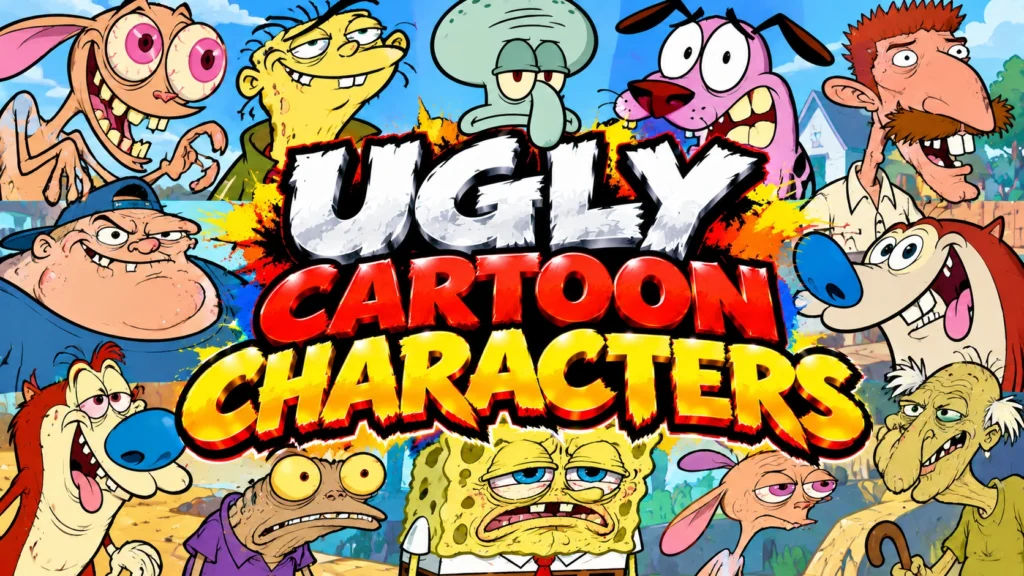
Not every cartoon character needs a beautiful face, perfect proportions, or an adorable appearance to become unforgettable. Some of the most recognizable animated personalities have oversized noses, crooked teeth, unusual body shapes, exaggerated expressions, or deliberately bizarre designs. These unusual features often make them funnier, more expressive, and easier to recognize.
Ugly cartoon characters appear in classic television shows, modern animated series, family movies, and adult comedies. From the strange facial expressions of Ren and Stimpy to Shrek’s green ogre appearance, their designs demonstrate how creative animation can turn unconventional looks into iconic entertainment.
This guide explores 45 memorable cartoon characters with unusual, exaggerated, or deliberately unattractive designs. You’ll discover their names, appearances, personalities, important relationships, and roles in their respective stories.
Since beauty is subjective, the word ugly describes unconventional cartoon designs rather than an objective judgment about a character’s worth.
Ugly Cartoon Characters At A Glance
The following directory includes 45 recognizable characters from animated television and movies.
| Character | Cartoon Or Movie | Distinctive Appearance |
|---|---|---|
| Shrek | Shrek | Green skin, tubular ears |
| Squidward Tentacles | SpongeBob SquarePants | Large nose, drooping eyes |
| Ren Höek | The Ren & Stimpy Show | Thin body, bulging eyes |
| Stimpy | The Ren & Stimpy Show | Bulbous nose, big smile |
| Beavis | Beavis and Butt-Head | Overbite, pointed hairstyle |
| Butt-Head | Beavis and Butt-Head | Long face, heavy eyelids |
| Ed | Ed, Edd n Eddy | Oversized jaw, lanky build |
| Eddy | Ed, Edd n Eddy | Short build, exaggerated grin |
| Eustace Bagge | Courage the Cowardly Dog | Bald head, angular features |
| Courage | Courage the Cowardly Dog | Pink body, huge expressions |
| Nigel Thornberry | The Wild Thornberrys | Enormous nose, prominent teeth |
| Mr. Crocker | The Fairly OddParents | Crooked posture, large ears |
| Gargamel | The Smurfs | Hooked nose, hunched body |
| Quasimodo | The Hunchback of Notre Dame | Asymmetrical body and face |
| Yzma | The Emperor’s New Groove | Angular face, thin frame |
| Ursula | The Little Mermaid | Purple skin, octopus tentacles |
| Roz | Monsters, Inc. | Heavy eyelids, wrinkled face |
| Randall Boggs | Monsters, Inc. | Long reptilian body |
| Sid | Ice Age | Wide eyes, buck teeth |
| Pumbaa | The Lion King | Oversized tusks, round snout |
| The Grinch | How the Grinch Stole Christmas! | Green fur, crooked grin |
| Oogie Boogie | The Nightmare Before Christmas | Sack-like body |
| Sideshow Bob | The Simpsons | Huge red hairstyle |
| Professor Farnsworth | Futurama | Wrinkled face, thick glasses |
| Peter Griffin | Family Guy | Round face, pronounced chin |
| Herbert | Family Guy | Stooped posture, long face |
| Mr. Mackey | South Park | Oversized head |
| Eric Cartman | South Park | Round body, simple features |
| Carl Brutananadilewski | Aqua Teen Hunger Force | Balding head, heavy build |
| Ed Bighead | Rocko’s Modern Life | Large head, permanent scowl |
| Bev Bighead | Rocko’s Modern Life | Broad face, oversized eyes |
| Filburt | Rocko’s Modern Life | Turtle shell, round glasses |
| Helga Pataki | Hey Arnold! | Unibrow, pigtails |
| Grandpa Lou Pickles | Rugrats | Balding head, loose features |
| Dr. Jumba Jookiba | Lilo & Stitch | Large alien body, four eyes |
| Philoctetes | Hercules | Goat legs, horns, red nose |
| Cruella de Vil | One Hundred and One Dalmatians | Gaunt face, two-tone hair |
| Jafar | Aladdin | Long face, angular beard |
| Madame Medusa | The Rescuers | Exaggerated makeup, red hair |
| Drizella Tremaine | Cinderella | Sharp nose, exaggerated expressions |
| Scar | The Lion King | Facial scar, dark mane |
| Wile E. Coyote | Looney Tunes | Scruffy fur, long snout |
| Tasmanian Devil | Looney Tunes | Huge mouth, shaggy body |
| Bluto | Popeye | Heavy build, thick beard |
| Skeletor | He-Man and the Masters of the Universe | Skull face, muscular body |
What Makes Cartoon Characters Look Ugly?
Animated characters often have exaggerated proportions because animators want audiences to understand their personalities immediately. Unusual faces, crooked smiles, awkward movements, and strange physical features can communicate humor, danger, discomfort, or insecurity without much dialogue.
Several visual techniques contribute to these designs:
- Exaggerated facial features: Large noses, bulging eyes, prominent teeth, and oversized mouths make expressions more noticeable.
- Unusual body proportions: Extremely tall, short, round, skinny, or asymmetrical figures create distinctive silhouettes.
- Unconventional colors: Green skin, purple bodies, and unnatural hair colors make animated figures stand out.
- Grotesque animation: Some cartoons deliberately emphasize wrinkles, saliva, distorted expressions, and uncomfortable close-ups.
- Visual characterization: A villain may have sharp angles and intimidating features, while a comedy character may have awkward or exaggerated proportions.
An unusual appearance does not necessarily indicate an evil personality. Shrek, Quasimodo, and Courage demonstrate that characters with unconventional designs can be compassionate, heroic, and emotionally engaging.
Iconic Ugly Cartoon Characters From Television
These television characters are especially recognizable for their exaggerated faces, strange proportions, and memorable personalities.
1. Squidward Tentacles – SpongeBob SquarePants
| Detail | Information |
|---|---|
| Franchise | SpongeBob SquarePants |
| Species | Octopus |
| Occupation | Krusty Krab cashier |
| Personality | Sarcastic, artistic, easily irritated |
| Voice Actor | Rodger Bumpass |
Squidward Tentacles is SpongeBob SquarePants’ grumpy neighbor and coworker. His large drooping nose, heavy eyelids, bald-looking head, and slender turquoise body create an instantly recognizable appearance.
Although his name suggests a squid, Squidward is officially depicted as an octopus, stylized with six visible limbs.
Squidward considers himself a sophisticated artist and musician. He enjoys playing the clarinet, painting, and appreciating fine art, but he rarely receives the admiration he expects.
His biggest frustration comes from living between SpongeBob and Patrick Star, whose energetic behavior constantly interrupts his desire for peace.
Squidward’s unusual design perfectly matches his exhausted expressions and dry humor. His character shows how a permanently annoyed face can become one of animation’s most recognizable features.
2. Ren Höek – The Ren & Stimpy Show
Ren Höek is a small, thin Chihuahua with a narrow body, enormous eyes, prominent ears, and an unsettling range of facial expressions.
His nervous, aggressive personality contrasts sharply with Stimpy’s innocent behavior. Ren frequently becomes frustrated over small problems and reacts with exaggerated anger.
The character’s appearance becomes especially bizarre during the show’s grotesque close-up sequences, where his teeth, wrinkles, and facial muscles are dramatically exaggerated.
Ren represents an intentionally uncomfortable style of cartoon design. His unpredictable behavior and strange expressions helped establish The Ren & Stimpy Show as an influential example of surreal and gross-out animation.
3. Stimpy – The Ren & Stimpy Show
Stimpson J. Cat, better known as Stimpy, is a cheerful red-and-white cat with a large blue nose, round body, and unusually wide smile.
Unlike Ren, Stimpy is generally affectionate, optimistic, and easily entertained. His innocent personality creates much of the comedy between the two characters.
Stimpy’s design includes oversized facial features and exaggerated body movements. He frequently appears in deliberately disgusting or absurd situations involving bodily humor.
Although Stimpy is more approachable than Ren, his extreme expressions can make him appear equally strange.
Together, Ren and Stimpy demonstrate how unconventional animation can build a memorable comedic partnership.
4. Beavis – Beavis and Butt-Head
Beavis is a teenage character recognized by his blond pompadour, narrow face, overbite, and constant nervous laughter.
He wears a blue Metallica shirt in his familiar classic design and spends much of his time watching music videos, discussing immature subjects, and following his friend Butt-Head into trouble.
Beavis is easily distracted and often demonstrates poor judgment. His excitement can quickly become uncontrollable, especially when he assumes his Cornholio persona.
The character’s deliberately awkward appearance reflects the series’ satirical portrayal of teenage immaturity.
Creator Mike Judge voices Beavis, giving him a distinctive high-pitched laugh and restless speaking style.
5. Butt-Head – Beavis and Butt-Head
Butt-Head is Beavis’s taller, dark-haired companion. His elongated face, heavy eyelids, prominent mouth, and hunched posture make him immediately recognizable.
He often acts as the more dominant member of the duo, frequently mocking Beavis despite displaying similarly poor judgment.
Butt-Head’s smug laugh and slow speaking style reinforce his deliberately irritating personality.
His appearance is intentionally unattractive in a caricatured sense, with exaggerated proportions that emphasize the show’s crude humor.
The contrast between Butt-Head’s misplaced confidence and his frequent failures forms an essential part of the series.
6. Ed – Ed, Edd n Eddy
Ed is the tallest member of the central trio in Ed, Edd n Eddy. His enormous jaw, uneven teeth, thick eyebrows, and awkward body proportions give him a distinctive appearance.
Despite his intimidating size, Ed is generally gentle, enthusiastic, and easily confused.
He loves monster movies, comic books, chickens, and unusual foods. His imagination often turns ordinary situations into elaborate adventures.
Ed has considerable physical strength but rarely approaches problems logically. Eddy frequently relies on him to carry out the trio’s neighborhood money-making schemes.
His friendship with Edd and Eddy is central to the show, and his innocent personality makes him far more lovable than his exaggerated appearance might suggest.
7. Eddy – Ed, Edd n Eddy
Eddy is the short, loud, ambitious leader of the three Eds. His oversized head, large tongue, exaggerated smile, and unusual proportions contribute to the series’ distinctive visual style.
He constantly develops schemes to earn money from neighborhood children, usually hoping to buy jawbreakers.
Eddy wants popularity, respect, and financial success but frequently undermines himself through selfish behavior.
His friendship with Ed and Edd remains important despite their disagreements.
The character’s exaggerated grin and overconfident expressions reflect his desire to impress others, even when his plans are obviously flawed.
8. Eustace Bagge – Courage the Cowardly Dog
Eustace Bagge is the elderly farmer who lives with his wife Muriel and their dog Courage in the fictional town of Nowhere, Kansas.
His bald head, oversized chin, thin limbs, and grumpy expressions give him an intentionally unpleasant appearance.
Eustace is selfish, stubborn, and frequently cruel toward Courage. He enjoys frightening the dog by wearing a frightening green mask and shouting his familiar insult, “Stupid dog!”
Despite his unpleasant behavior, Eustace occasionally reveals vulnerability and insecurity.
His relationship with Courage contrasts sharply with Muriel’s kindness, helping establish the show’s mixture of comedy, horror, and family affection.
9. Courage – Courage the Cowardly Dog
Courage is a small pink dog with thin black ears, prominent teeth, and extremely expressive eyes.
His appearance changes dramatically whenever he becomes frightened. His mouth stretches, his eyes expand, and his body transforms into absurd shapes.
Although Courage is naturally anxious, he repeatedly protects Muriel and Eustace from supernatural creatures, monsters, and dangerous strangers.
His courage comes from acting despite fear rather than being fearless.
The show’s surreal animation regularly distorts Courage’s face for both humor and horror.
His unusual expressions make him an excellent example of how deliberately strange cartoon designs can support emotional storytelling.
10. Nigel Thornberry – The Wild Thornberrys
Nigel Thornberry is a wildlife documentary presenter and the father of Eliza and Debbie Thornberry.
His enormous red nose, prominent front teeth, bushy mustache, and thin face create one of Nickelodeon’s most distinctive character designs.
Nigel is enthusiastic, adventurous, and deeply passionate about animals. His excitement often leads him into dangerous or embarrassing situations.
Despite his strange appearance and eccentric behavior, Nigel is a devoted family man who genuinely respects wildlife.
Tim Curry voices Nigel in the original animated series.
His exaggerated face and expressive voice helped make him a particularly recognizable character in internet memes and nostalgic cartoon discussions.
11. Mr. Crocker – The Fairly OddParents
Denzel Quincy Crocker is Timmy Turner’s eccentric schoolteacher and one of the recurring antagonists in The Fairly OddParents.
His large ears, hunched posture, crooked teeth, and unusual neck movements make him visually distinctive.
Crocker is obsessed with proving that fairy godparents exist. His obsession frequently causes him to behave irrationally and embarrass himself in public.
Despite being a teacher, he often neglects ordinary responsibilities while pursuing evidence of magical creatures.
His exaggerated body movements become especially noticeable whenever he excitedly announces his belief in fairies.
Crocker’s design helps communicate obsession, instability, and comic desperation.
12. Gargamel – The Smurfs
Gargamel is the recurring villain of The Smurfs, recognized by his long hooked nose, bald head, black robe, and hunched posture.
He lives in a rundown home with his cat Azrael and continually attempts to capture the Smurfs.
Depending on the story, Gargamel wants to use the little blue creatures for magical purposes, financial gain, or personal revenge.
His personality combines greed, jealousy, impatience, and frequent incompetence.
Although Gargamel is an antagonist, his repeated failures make him a comedic figure.
His traditionally exaggerated witchlike appearance draws on classic fairy-tale villain designs.
13. Sideshow Bob – The Simpsons
Robert Terwilliger, better known as Sideshow Bob, is a highly educated criminal and recurring enemy of Bart Simpson.
His enormous palm-tree-like red hairstyle, large feet, long face, and theatrical expressions create an unmistakable silhouette.
Bob originally worked as Krusty the Clown’s sidekick before becoming a major antagonist.
He possesses considerable intelligence, appreciates classical music, and frequently attempts elaborate revenge schemes against Bart.
Kelsey Grammer voices the character, contributing to his sophisticated yet comically dramatic personality.
Bob’s appearance creates a strong visual contrast between his intellectual ambitions and the absurd situations that repeatedly defeat him.
14. Professor Hubert J. Farnsworth – Futurama
Professor Hubert J. Farnsworth is an elderly scientist, inventor, and founder of Planet Express in Futurama.
His wrinkled face, exceptionally thin body, oversized glasses, and bald head emphasize his advanced age.
Despite being a brilliant inventor, Farnsworth frequently displays forgetfulness, questionable judgment, and indifference toward the dangers faced by his employees.
His inventions range from remarkable scientific breakthroughs to highly dangerous experiments.
Farnsworth is also a distant relative of Philip J. Fry.
His exaggerated elderly appearance supports the show’s satirical treatment of science, technology, and human irresponsibility.
15. Peter Griffin – Family Guy
Peter Griffin is the central character of Family Guy, an animated sitcom created by Seth MacFarlane.
His round face, distinctive chin, prominent glasses, and large body create a simple but instantly recognizable design.
Peter lives in Quahog, Rhode Island, with his wife Lois and their children Meg, Chris, and Stewie.
He is impulsive, immature, and frequently makes irrational decisions that create problems for his family.
Although his behavior is often selfish, the series occasionally shows his affection for his relatives and friends.
His physical appearance plays a major role in the program’s slapstick humor, exaggerated reactions, and absurd visual jokes.
16. Herbert – Family Guy
Herbert is an elderly resident of Quahog known for his thin frame, stooped posture, wrinkled face, and soft, high-pitched voice.
He is a recurring character whose inappropriate interest in Chris Griffin forms the basis of disturbing adult-oriented jokes.
His frail appearance contrasts with the unsettling nature of his behavior.
Herbert is deliberately written as an uncomfortable comedic figure, and the show uses his exaggerated physical design to emphasize that discomfort.
The character illustrates how adult animation sometimes uses unconventional appearances to reinforce dark or socially provocative humor.
17. Mr. Mackey – South Park
Mr. Mackey is the school counselor at South Park Elementary.
His unusually large head, small body, round glasses, and distinctive manner of speaking make him easy to recognize.
He frequently ends statements with “m’kay,” a verbal habit that has become closely associated with the character.
Mr. Mackey often attempts to educate students about appropriate behavior, substance abuse, and personal responsibility.
However, his own insecurities and occasional poor decisions undermine his authority.
His oversized head is one of the most obvious examples of intentionally disproportionate character design in South Park.
18. Eric Cartman – South Park
Eric Theodore Cartman is one of the four central boys in South Park.
His round body, large face, red jacket, yellow mittens, and blue-and-yellow hat create a simple but recognizable silhouette.
Cartman is manipulative, selfish, prejudiced, and exceptionally determined to get what he wants.
He frequently clashes with Kyle Broflovski and exploits his friends for personal gain.
Although his character design is relatively simple, exaggerated facial expressions and body movements make him visually distinctive.
Cartman demonstrates that memorable cartoon appearances do not always require elaborate artistic detail. Personality and recognizable clothing can be equally important.
19. Carl Brutananadilewski – Aqua Teen Hunger Force
Carl Brutananadilewski is the unpleasant neighbor of the main characters in Aqua Teen Hunger Force.
His balding head, thick mustache, large body, and casual clothing establish his deliberately unpolished appearance.
Carl is loud, impatient, and frequently irritated by the bizarre behavior of Master Shake, Frylock, and Meatwad.
He enjoys sports, cars, and adult entertainment, while displaying limited interest in maintaining healthy relationships with his neighbors.
His ordinary-looking suburban lifestyle contrasts with the surreal events surrounding him.
Carl’s exaggerated appearance and blunt dialogue make him a recognizable character in adult animated comedy.
20. Ed Bighead – Rocko’s Modern Life
Ed Bighead is Rocko’s short-tempered neighbor in Rocko’s Modern Life.
He is a large green cane toad with a broad head, drooping mouth, prominent eyes, and a permanently irritated expression.
Ed works for the Conglom-O Corporation and frequently complains about Rocko and his friends.
His personality is pessimistic, argumentative, and suspicious of anything unfamiliar.
Despite his unpleasant attitude, Ed occasionally displays affection for his wife Bev.
His exaggerated amphibian appearance fits the show’s surreal character designs and satirical portrayal of suburban life.
21. Bev Bighead – Rocko’s Modern Life
Bev Bighead is Ed Bighead’s wife, a green cane toad with a broad face, large eyes, distinctive hair, and an expressive smile.
Unlike her grumpy husband, Bev is generally outgoing, friendly, and comfortable expressing her feelings.
She often welcomes Rocko despite Ed’s hostility toward their neighbor.
Her exaggerated appearance reflects the show’s preference for unusual animal designs rather than realistic proportions.
Bev is important because she introduces warmth and social energy into the Bighead household.
Her relationship with Ed also creates many of the show’s domestic comedy situations.
22. Filburt – Rocko’s Modern Life
Filburt Shellbach is a neurotic turtle and one of Rocko’s closest friends.
His large round glasses, green skin, oversized shell, and anxious expressions give him an awkward appearance.
Filburt frequently worries about cleanliness, health, and potential disasters.
His nervous personality often turns harmless situations into moments of exaggerated panic.
Despite his many fears, he remains a loyal friend who participates in Rocko and Heffer’s adventures.
Filburt’s appearance and behavior work together to create a character whose exaggerated anxiety is central to his humor.
23. Helga Pataki – Hey Arnold!
Helga Geraldine Pataki is a central character in Hey Arnold! and one of Arnold’s classmates.
Her prominent unibrow, blonde pigtails, oversized pink bow, and pink dress create a distinctive cartoon appearance.
Helga frequently behaves aggressively toward Arnold, although she secretly has strong romantic feelings for him.
Much of her behavior comes from insecurity, family difficulties, and a desire to hide her vulnerability.
She is intelligent, poetic, emotionally complex, and often misunderstood.
Helga’s unconventional design contributes to her recognizable personality, but her emotional depth makes her much more than a visual joke.
24. Grandpa Lou Pickles – Rugrats
Louis “Lou” Pickles is the grandfather of Tommy Pickles and a recurring member of the Rugrats family.
His balding head, wrinkles, rounded nose, and loose facial features emphasize his elderly appearance.
Lou enjoys telling stories, spending time with his grandchildren, and reminiscing about his earlier life.
He often falls asleep while supervising the babies, allowing them to begin their imaginative adventures.
Although he can be forgetful or distracted, Lou is affectionate toward his family.
His design follows the show’s heavily exaggerated human proportions, which make both children and adults visually expressive.
Ugly Cartoon Characters From Animated Movies
Animated movies frequently use strange physical features to create lovable outsiders, eccentric sidekicks, and memorable villains. The following characters demonstrate how unusual appearances contribute to storytelling.
25. Shrek – Shrek
| Detail | Information |
|---|---|
| Franchise | Shrek |
| Species | Ogre |
| Role | Main protagonist |
| Personality | Sarcastic, protective, independent |
| Original Voice Actor | Mike Myers |
| Important Relationships | Princess Fiona, Donkey |
Shrek is a large green ogre with a round head, tubular ears, broad shoulders, and a prominent nose.
His appearance is deliberately unconventional because the story challenges traditional fairy-tale expectations of beauty and heroism.
At the beginning of the original film, Shrek prefers living alone in his swamp. He frightens strangers because he believes isolation will protect him from rejection.
His life changes after he meets Donkey and becomes involved in rescuing Princess Fiona.
Despite his intimidating exterior, Shrek is thoughtful, loyal, and capable of deep affection.
His relationship with Fiona reinforces the franchise’s central message that appearance does not determine character or personal worth.
Shrek is particularly significant among ugly cartoon characters because his unconventional appearance is essential to the story rather than simply a source of comedy.
26. Quasimodo – The Hunchback of Notre Dame
Quasimodo is the protagonist of Disney’s 1996 animated film The Hunchback of Notre Dame, adapted from Victor Hugo’s novel.
He has an asymmetrical face, a pronounced spinal curvature, and other visible physical differences.
Raised in isolation within Notre Dame Cathedral, Quasimodo works as a bell-ringer and dreams of experiencing the world beyond the cathedral.
His guardian, Judge Claude Frollo, teaches him to fear public rejection.
However, Quasimodo demonstrates kindness, courage, empathy, and a strong desire for friendship.
His relationship with Esmeralda helps him recognize that he deserves dignity and acceptance.
Voiced by Tom Hulce in the original film, Quasimodo is an important example of a character whose story directly challenges prejudice based on physical appearance.
27. Yzma – The Emperor’s New Groove
Yzma is the principal antagonist of Disney’s The Emperor’s New Groove.
Her extremely thin body, angular face, long eyelashes, dramatic makeup, and elaborate purple clothing create an intentionally exaggerated appearance.
Yzma formerly serves as Emperor Kuzco’s adviser before attempting to seize his throne.
She relies on magical potions, elaborate schemes, and assistance from her loyal but easily confused associate Kronk.
Although Yzma considers herself highly intelligent, her plans repeatedly fail because of mistakes and comic misunderstandings.
Her appearance complements her theatrical personality and sharp speaking style.
Eartha Kitt’s original voice performance contributes significantly to the character’s memorable presence.
28. Ursula – The Little Mermaid
Ursula is the sea witch and primary villain of Disney’s 1989 animated film The Little Mermaid.
Her design combines a humanoid upper body with an octopus-like lower body, featuring dark tentacles, lavender-purple skin, white hair, and dramatic makeup.
Ursula makes dangerous magical agreements with underwater creatures, exploiting their desires to gain power.
Her most important deal involves Ariel, who wants to experience life as a human.
Ursula is manipulative, confident, theatrical, and highly persuasive.
Her exaggerated expressions and sweeping movements make her one of Disney’s most visually recognizable villains.
The character was originally voiced by Pat Carroll.
29. Roz – Monsters, Inc.
Roz is a character in Pixar’s Monsters, Inc., where she initially appears to be a stern administrator responsible for paperwork at the company’s scare floor.
She has a slug-like body, wrinkled face, heavy eyelids, small glasses, and an extremely slow manner of speaking.
Roz rarely displays excitement and frequently criticizes Mike Wazowski for failing to submit his paperwork properly.
Her quiet, intimidating presence contrasts with Mike’s energetic personality.
The film eventually reveals that Roz has a more important responsibility than her administrative role initially suggests.
Voiced by Bob Peterson, Roz is memorable because her unusual appearance works perfectly with her dry humor and understated authority.
30. Randall Boggs – Monsters, Inc.
Randall Boggs is a reptilian monster with an elongated body, multiple legs, narrow eyes, and an unsettling grin.
His flexible body allows him to move stealthily, while his camouflage ability lets him blend into surrounding environments.
Randall works as a scarer at Monsters, Incorporated, and competes with James P. Sullivan.
Unlike Sulley, Randall approaches scaring with a ruthless desire for recognition and success.
His ambitious personality eventually leads him into dangerous schemes.
The combination of his reptilian appearance, threatening movements, and camouflage powers makes Randall an effective animated antagonist.
Steve Buscemi provides his voice in the original film.
31. Sid – Ice Age
Sid is a prehistoric ground sloth and one of the central characters in the Ice Age film franchise.
He has an elongated neck, buck teeth, a flattened nose, widely spaced eyes, and a distinctive lisp.
Sid is talkative, clumsy, enthusiastic, and frequently unaware of how annoying others find him.
Despite his awkward appearance, he is deeply loyal to his companions Manny and Diego.
His attempts to help often create additional problems, but his optimism makes him an important emotional member of their group.
John Leguizamo voices Sid in the original films.
Sid’s design emphasizes comedy rather than conventional cuteness, allowing his facial expressions and movements to create much of the franchise’s humor.
32. Pumbaa – The Lion King
Pumbaa is a friendly warthog introduced in Disney’s The Lion King.
His broad snout, large tusks, round belly, thin legs, and shaggy mane create a distinctive appearance based on an exaggerated version of a real warthog.
Pumbaa lives with his best friend Timon and helps raise Simba after the young lion leaves his home.
He follows the relaxed philosophy of Hakuna Matata, encouraging others to avoid unnecessary worry.
Although Pumbaa can be sensitive about how others perceive him, he is kind, protective, and loyal.
His appearance contrasts with his gentle personality, reinforcing the idea that physical features should not determine how someone is treated.
33. The Grinch – How the Grinch Stole Christmas!
The Grinch is a green, furry character created by Dr. Seuss and featured in several animated adaptations of How the Grinch Stole Christmas!
His narrow eyes, pointed fingers, exaggerated grin, and shaggy green body make him instantly recognizable.
The Grinch lives apart from the residents of Whoville and initially despises their enthusiastic Christmas celebrations.
He develops a plan to steal their holiday decorations and presents, believing that doing so will eliminate their happiness.
His experience eventually challenges his understanding of the holiday.
The character’s curled smile and expressive eyebrows are essential to his mischievous appearance.
Different adaptations feature different performers, including Boris Karloff’s narration and Grinch voice in the classic 1966 television special.
34. Oogie Boogie – The Nightmare Before Christmas
Oogie Boogie is a villain from Tim Burton’s The Nightmare Before Christmas, directed by Henry Selick.
His body resembles a large burlap sack with irregular stitching, a rounded shape, and an unsettling smile.
Unlike ordinary human characters, Oogie Boogie has a monstrous construction associated with insects and other crawling creatures.
He enjoys gambling, frightening his victims, and placing others in dangerous situations.
His lair contains elaborate traps and casino-inspired imagery.
Oogie Boogie’s design is particularly effective because it combines an everyday material with a grotesque monster concept.
Ken Page voiced him in the original 1993 film.
35. Dr. Jumba Jookiba – Lilo & Stitch
Dr. Jumba Jookiba is an eccentric alien scientist in Disney’s Lilo & Stitch.
His enormous purple body, four eyes, thick limbs, and exaggerated facial features create an unusual appearance.
Jumba is responsible for creating Experiment 626, the genetically engineered creature later named Stitch.
Initially portrayed as a dangerous scientist, Jumba gradually becomes an important member of Stitch and Lilo’s extended family.
He is highly intelligent, scientifically talented, and often morally flexible.
His inventions and experiments regularly create unexpected problems.
Despite his intimidating appearance, Jumba develops genuine affection for his companions.
David Ogden Stiers originally voiced the character.
36. Philoctetes – Hercules
Philoctetes, commonly called Phil, is a satyr and experienced trainer of heroes in Disney’s Hercules.
His design combines a short humanoid upper body with goat legs, horns, pointed ears, a prominent red nose, and a stocky frame.
Phil has trained numerous aspiring heroes but has become cynical after experiencing repeated disappointment.
He initially doubts Hercules’ potential before agreeing to help him develop his strength and fighting abilities.
Although Phil is impatient and argumentative, he eventually becomes a loyal mentor.
Danny DeVito voices him in the original 1997 film.
Phil’s exaggerated design makes him both comedic and instantly identifiable as a creature from Greek mythology.
Ugly Cartoon Villains With Strange And Scary Designs
Villains often feature angular faces, intimidating expressions, unusual clothing, and deliberately exaggerated features. These design choices help communicate danger, ambition, or cruelty.
37. Cruella De Vil – One Hundred and One Dalmatians
Cruella de Vil is the fashion-obsessed villain of Disney’s animated film One Hundred and One Dalmatians.
Her extremely thin frame, sharp facial features, pale skin, and black-and-white hair create a striking appearance.
Cruella’s exaggerated design reflects her dramatic personality and obsession with luxury.
Her desire to make a coat from Dalmatian puppies establishes her cruelty and selfishness.
She frequently loses her temper, resulting in distorted facial expressions and frantic movements.
Betty Lou Gerson originally voiced Cruella in the 1961 animated film.
Her design remains an example of how costume, silhouette, and facial exaggeration can establish a villain’s identity immediately.
38. Jafar – Aladdin
Jafar is the Royal Vizier and primary antagonist of Disney’s Aladdin.
His tall, narrow body, long angular face, pointed beard, and elaborate black-and-red clothing create a threatening silhouette.
Jafar uses political manipulation and magical ambitions to pursue control over Agrabah.
He is calculating, arrogant, and obsessed with obtaining greater authority.
His staff, shaped like a cobra, reinforces his association with deception and danger.
Jonathan Freeman originally voiced Jafar in the animated film.
His visual design contrasts with Aladdin’s more approachable appearance, helping audiences recognize their opposing personalities.
39. Madame Medusa – The Rescuers
Madame Medusa is the primary antagonist of Disney’s 1977 animated film The Rescuers.
Her wild red hair, exaggerated makeup, wide mouth, and heavily expressive face make her visually distinctive.
She is a greedy pawnshop owner who kidnaps a young orphan named Penny and forces her to search for a valuable diamond.
Medusa’s selfishness and impatience frequently lead to explosive emotional reactions.
Her movements are exaggerated, especially when she becomes angry or frustrated.
Geraldine Page provided the original voice performance.
Medusa demonstrates how dramatic facial animation can make an otherwise human-looking villain appear intimidating and grotesque.
40. Drizella Tremaine – Cinderella
Drizella Tremaine is one of Cinderella’s stepsisters in Disney’s 1950 animated film Cinderella.
She has dark hair, exaggerated facial features, a prominent nose, and expressive movements that emphasize her unpleasant behavior.
Drizella frequently mocks Cinderella and competes with her sister Anastasia for attention.
Her jealousy, selfishness, and entitlement reflect the values encouraged by their mother, Lady Tremaine.
Unlike Cinderella, Drizella generally approaches social situations with arrogance rather than kindness.
Her character design is especially expressive during scenes involving arguments, disappointment, and sibling rivalry.
Drizella’s appearance contributes to the visual contrast between the stepsisters and Cinderella.
41. Scar – The Lion King
Scar is the main antagonist of Disney’s The Lion King.
His slender body, dark mane, narrow green eyes, facial scar, and angular features distinguish him from other lions.
Scar is the brother of Mufasa and uncle of Simba.
Driven by jealousy and a desire for power, he plots to become king of the Pride Lands.
Rather than relying primarily on physical strength, Scar uses deception, manipulation, and alliances to achieve his goals.
Jeremy Irons originally voiced Scar in the 1994 animated film.
His design emphasizes menace and calculation, making his appearance noticeably different from Mufasa’s more commanding and balanced look.
Classic Funny And Weird-Looking Cartoon Characters
Classic animation often relies on physical comedy, elastic movements, and distorted facial expressions. Some characters become especially memorable through the way their bodies react to repeated failures.
42. Wile E. Coyote – Looney Tunes
Wile E. Coyote is a famous animated predator who repeatedly attempts to capture the Road Runner.
His thin body, long snout, scruffy brown fur, and frequently exhausted expressions contribute to his recognizable design.
Although Wile E. considers himself intelligent, his elaborate schemes usually end in disaster.
He frequently purchases equipment from the fictional ACME Corporation, including rockets, explosives, traps, and unusual machines.
His physical appearance often changes dramatically after accidents.
These temporary distortions, including flattened faces and stretched bodies, are central to his comedy.
Wile E. Coyote is a classic example of slapstick animation, where physical exaggeration communicates frustration without extensive dialogue.
43. Tasmanian Devil – Looney Tunes
The Tasmanian Devil, commonly called Taz, is a wild cartoon creature with a stocky body, oversized mouth, thick fur, and powerful jaws.
He is inspired by the real Tasmanian devil, although his cartoon behavior and appearance are highly exaggerated.
Taz is best known for moving in a rapidly spinning whirlwind that destroys objects in his path.
His appetite is enormous, and he frequently attempts to eat almost anything he encounters.
Although he appears aggressive and unpredictable, some stories portray him as capable of affection and loyalty.
His exaggerated teeth, wild movements, and rough appearance make him one of the most recognizable physically comedic characters in Looney Tunes.
44. Bluto – Popeye
Bluto is a recurring antagonist and rival of Popeye the Sailor.
He has a large muscular body, thick beard, broad face, and intimidating expression.
Bluto frequently competes with Popeye for Olive Oyl’s attention and uses physical strength to bully others.
Although he is much larger than Popeye, his advantage usually disappears when Popeye gains extraordinary strength after eating spinach.
Bluto is aggressive, jealous, and overconfident.
His oversized physique creates a strong contrast with Popeye’s wiry build.
The character’s exaggerated appearance reflects classic animation’s reliance on distinctive silhouettes and physically expressive rivalries.
45. Skeletor – He-Man and the Masters of the Universe
Skeletor is the principal antagonist of He-Man and the Masters of the Universe.
His skeletal face, muscular blue body, purple hood, and intimidating armor create one of fantasy animation’s most distinctive villain designs.
Skeletor seeks control over Castle Grayskull and the powerful secrets associated with it.
He commands dangerous allies and frequently confronts He-Man and the heroic defenders of Eternia.
Despite his frightening appearance, Skeletor is often portrayed as theatrical, sarcastic, and easily frustrated by failure.
His skeletal facial design makes him visually different from ordinary human villains.
Alan Oppenheimer provided his iconic voice in the original 1980s animated series.
Skeletor demonstrates how an intentionally frightening character can become popular through a combination of appearance, dialogue, and exaggerated personality.
Who Are The Most Famous Ugly Cartoon Characters?
Several characters are especially recognizable for their unusual physical designs and long-standing presence in popular animation.
| Character | Why They Stand Out |
|---|---|
| Shrek | A green ogre who challenges traditional beauty standards |
| Squidward | A grumpy octopus with a prominent nose |
| Ren and Stimpy | A duo famous for grotesque facial expressions |
| Beavis and Butt-Head | Teenagers with deliberately awkward character designs |
| Quasimodo | A kindhearted hero judged unfairly for his appearance |
| Sid | An awkward but loyal prehistoric sloth |
| Yzma | An eccentric villain with an extremely angular appearance |
| The Grinch | A furry green character with a mischievous grin |
| Nigel Thornberry | An adventurer with oversized teeth and an enormous nose |
| Skeletor | A fantasy villain recognized by his skeletal face |
These characters represent different approaches to unconventional animation. Some are designed for comedy, others for horror or fantasy, and several use their unusual appearances to communicate deeper themes.
Ugly Cartoon Characters And Their Personalities
One of the most interesting aspects of unusual cartoon designs is the relationship between physical appearance and personality.
| Character | Personality | Main Story Role |
|---|---|---|
| Shrek | Protective, sarcastic | Hero |
| Squidward | Irritable, artistic | Supporting character |
| Ren Höek | Angry, impatient | Comedy protagonist |
| Stimpy | Cheerful, innocent | Comedy protagonist |
| Eustace Bagge | Grumpy, selfish | Supporting antagonist |
| Courage | Nervous, loyal | Hero |
| Gargamel | Greedy, obsessive | Villain |
| Quasimodo | Gentle, courageous | Hero |
| Yzma | Ambitious, theatrical | Villain |
| Sid | Friendly, clumsy | Comic sidekick |
| Pumbaa | Optimistic, loyal | Supporting hero |
| Scar | Manipulative, jealous | Villain |
| Wile E. Coyote | Determined, inventive | Comic antagonist |
| Skeletor | Power-hungry, sarcastic | Villain |
The distinction matters because unusual or unattractive features do not automatically indicate negative behavior. Some of the kindest figures on this list have unconventional appearances, while several villains use polished clothing and carefully maintained appearances to disguise selfish intentions.
Male And Female Ugly Cartoon Characters
Cartoon designers use exaggerated features for characters of all genders, although the reasons behind those designs vary.
Male Ugly Cartoon Characters
Examples include Shrek, Squidward, Ren, Beavis, Butt-Head, Ed, Eustace Bagge, Nigel Thornberry, Gargamel, Sid, Jafar, and Skeletor.
Many of these characters have oversized noses, unusual jaws, exaggerated facial expressions, or distinctive silhouettes. Their designs frequently emphasize humor, intimidation, awkwardness, or emotional insecurity.
Female Ugly Cartoon Characters
Examples include Yzma, Ursula, Roz, Bev Bighead, Helga Pataki, Cruella de Vil, Madame Medusa, and Drizella Tremaine.
Their appearances range from highly stylized fantasy designs to exaggerated human facial features.
Importantly, some of these characters are deliberately portrayed as unconventional rather than objectively unattractive. Helga’s unibrow, for example, is a recognizable design feature that supports her distinctive personality.
Ugly Cartoon Characters With Important Relationships
Character relationships often explain why these unusual animated personalities are memorable beyond their appearances.
| Character | Important Connection | Relationship |
|---|---|---|
| Shrek | Fiona | Wife |
| Shrek | Donkey | Close friend |
| Squidward | SpongeBob | Neighbor and coworker |
| Ren | Stimpy | Friend and companion |
| Beavis | Butt-Head | Best friend |
| Ed | Edd and Eddy | Friends |
| Eustace | Muriel | Wife |
| Courage | Muriel | Loving caregiver |
| Gargamel | Azrael | Pet cat |
| Quasimodo | Esmeralda | Friend |
| Yzma | Kronk | Assistant |
| Ursula | Ariel | Magical deal and conflict |
| Randall | Sulley | Rival |
| Sid | Manny and Diego | Close companions |
| Pumbaa | Timon | Best friend |
| Scar | Mufasa | Brother |
| Jumba | Stitch | Creator of Experiment 626 |
| Skeletor | He-Man | Enemy |
These connections reveal that even cartoon characters with grotesque or strange designs participate in complex friendships, rivalries, families, and emotional relationships.
Why Do Ugly Cartoon Characters Become So Popular?
Unconventional cartoon designs attract attention for several important storytelling and artistic reasons.
Their Appearances Are Easy To Recognize
A character with an unusually large nose, skeletal face, or distinctive hairstyle can often be identified from a silhouette alone.
This visual clarity is valuable in animation, where characters must remain recognizable during movement, action, and emotional scenes.
Their Expressions Create Comedy
Animation allows artists to stretch, compress, and distort faces beyond realistic physical limitations.
Characters such as Ren, Stimpy, Ed, and Courage use extreme facial reactions to communicate surprise, anger, disgust, or fear.
These exaggerated expressions often become funnier precisely because they look unrealistic.
They Challenge Beauty Standards
Characters such as Shrek and Quasimodo challenge the idea that physical attractiveness determines someone’s value.
Both characters experience rejection because of their appearances, yet their stories emphasize compassion, courage, and personal growth.
Their experiences add emotional depth to stories that might otherwise rely entirely on visual comedy.
Their Designs Support Their Personalities
The appearance of a character can communicate personality before they speak.
Skeletor’s skull face suggests danger, while Squidward’s drooping eyes communicate exhaustion and irritation.
Similarly, Yzma’s dramatic proportions reinforce her theatrical and ambitious personality.
They Become Memorable Through Repetition
Recurring facial expressions, physical jokes, costumes, and recognizable movements strengthen audience familiarity.
Characters from SpongeBob SquarePants, The Simpsons, and Looney Tunes have become enduring parts of cartoon culture partly because viewers immediately recognize their visual identities.
Interesting Facts About Ugly Cartoon Characters
Several facts reveal how unusual appearances contribute to recognizable animated characters.
- Shrek’s appearance is central to the story. His identity as an ogre directly supports the franchise’s themes of prejudice and acceptance.
- Squidward is an octopus. Despite his name, the character is stylized as an octopus with six visible limbs.
- Ren and Stimpy popularized grotesque close-ups. Their series frequently used detailed, exaggerated imagery to create uncomfortable comedy.
- Quasimodo originates from literature. Disney’s animated character is adapted from Victor Hugo’s The Hunchback of Notre-Dame.
- Skeletor has a skeletal face. His skull-like head forms one of the most recognizable villain silhouettes in fantasy animation.
- Sid’s unusual voice is deliberate. John Leguizamo’s performance helped establish the sloth’s distinctive lisp and awkward comic personality.
- Courage’s design changes dramatically. His body and facial features are frequently distorted to communicate fear.
- The Grinch has appeared in several adaptations. His visual appearance and personality have been interpreted differently across animated and live-action productions.
These details help explain why exaggerated physical features can become essential parts of a character’s identity.
Read Next
Explore more helpful guides from this category.


Frequently Asked Questions
Who Is The Ugliest Cartoon Character?
There is no official answer because ugliness is subjective. Ren Höek, Stimpy, Squidward, and Beavis are frequently associated with deliberately awkward or grotesque designs. Shrek is another prominent example because his unconventional appearance plays an important role in his story.
What Are The Most Famous Ugly Cartoon Characters?
Some of the most recognizable examples include Shrek, Squidward, Ren, Stimpy, Beavis, Butt-Head, Gargamel, Sid, Yzma, and the Grinch. Their unusual designs make them easy to identify across different generations of animation.
Which Ugly Cartoon Characters Are Actually Heroes?
Shrek, Quasimodo, Courage, Sid, and Pumbaa are heroic or sympathetic characters with unconventional appearances. Their stories demonstrate that physical beauty and moral goodness are separate qualities.
Who Are The Famous Ugly Cartoon Villains?
Gargamel, Yzma, Ursula, Scar, Jafar, Cruella de Vil, Oogie Boogie, and Skeletor are well-known animated villains whose designs incorporate exaggerated, strange, or intimidating visual features.
Which Ugly Cartoon Characters Have Big Noses?
Squidward Tentacles, Nigel Thornberry, Gargamel, Philoctetes, and several characters from Ed, Edd n Eddy have particularly prominent or exaggerated noses.
What Cartoon Characters Have Weird Faces?
Ren Höek, Stimpy, Beavis, Butt-Head, Eustace Bagge, Yzma, Roz, and Madame Medusa are notable for their unusual facial structures or dramatically exaggerated expressions.
Are Ugly Cartoon Characters Designed That Way On Purpose?
Many are. Animators deliberately manipulate facial proportions, body shapes, colors, and expressions to communicate personality, create comedy, or establish a distinctive visual identity. However, whether a character looks ugly remains a matter of personal interpretation.
Which Ugly Cartoon Characters Are From Nickelodeon?
Ren, Stimpy, Squidward, Nigel Thornberry, Mr. Crocker, Ed Bighead, Bev Bighead, Filburt, Helga Pataki, and Grandpa Lou Pickles are examples from Nickelodeon animated series.
Which Ugly Cartoon Characters Are From Disney Movies?
Examples include Quasimodo, Yzma, Ursula, Pumbaa, Jafar, Cruella de Vil, Madame Medusa, Drizella Tremaine, Scar, and Philoctetes. Pixar characters such as Roz and Randall Boggs also belong to Disney-owned animated film franchises.
How Many Ugly Cartoon Characters Are There?
There is no official total. The category depends on subjective judgments about appearance and includes characters from countless animated productions. This guide covers 45 distinctive characters rather than claiming that only 45 exist.
Conclusion
Ugly cartoon characters demonstrate that memorable animation depends on creativity, personality, and expressive design rather than conventional beauty. Oversized noses, crooked smiles, exaggerated proportions, and unusual body shapes can make animated personalities immediately recognizable.
Characters such as Shrek and Quasimodo use unconventional appearances to explore kindness and acceptance, while Ren, Stimpy, Squidward, and Beavis rely on exaggerated expressions to create comedy. Villains such as Yzma, Gargamel, and Skeletor use distinctive designs to establish their threatening or theatrical personalities.
These 45 characters represent different animation styles, from classic slapstick cartoons to modern animated movies and adult television comedies.
Their enduring appeal shows that an unusual appearance can become a storytelling strength. Ultimately, what makes these characters memorable is not simply how they look, but how their designs connect with their personalities, relationships, and stories.